Where is the feature?
On the tongue-facing or palate-facing side of an incisor.

Shovel-shaped incisors have pronounced marginal ridges along the sides of their tongue-facing or palate-facing surface. The area between the ridges looks hollowed, rather like a shallow shovel. This is a natural variation in tooth shape, especially in upper incisors. The name describes neither a cavity nor an abnormality that automatically requires treatment.
For training & practice ↓
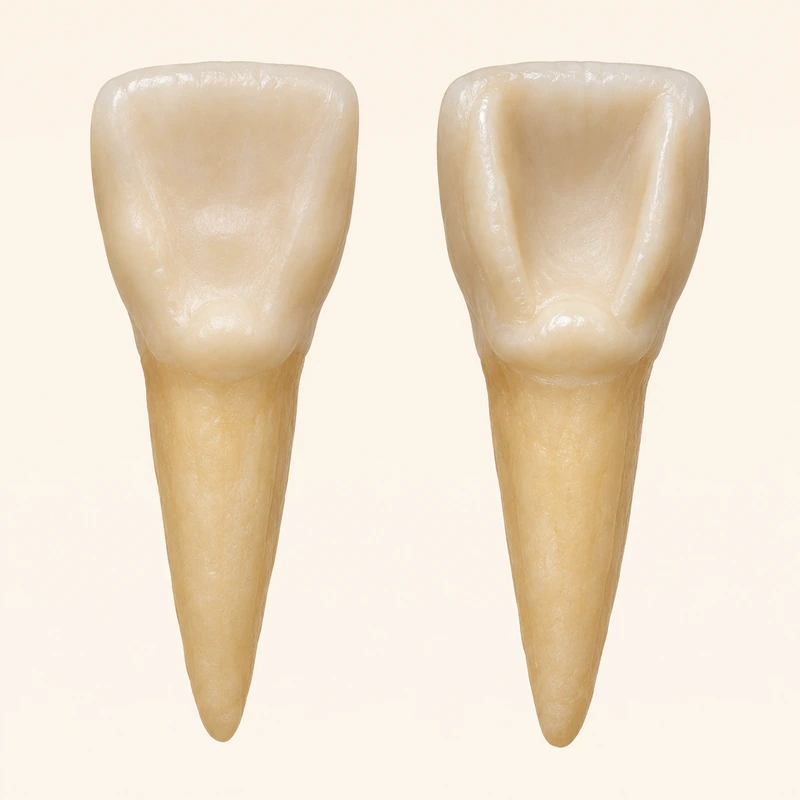
The shovel-like shape is on the inner side of the incisor. Marginal ridges border a depression. The biting edge does not have to be damaged or unusually shaped.
Ridges can be subtle or pronounced. These features arise during tooth development. A single tooth cannot reliably establish a person’s ancestry or genetic findings.
A natural depression is not automatically decay. Examination establishes whether the surface is healthy, cleanable or altered. A healthy shape variant does not need changing just because it has a name.
On the tongue-facing or palate-facing side of an incisor.
No; treatment depends on the actual findings.
No; one trait cannot reliably do that.
Three steps. No audio.
Each scene can also be selected manually.

Silent educational film with German on-screen text and simplified teaching images. Not a patient case or a promised treatment outcome. The full English explanation is available as text.
Shovel shape describes the configuration of marginal ridges. A defect involves loss or abnormal development of tooth tissue. A visible depression alone does not establish a defect.
The shape alone is not a disease. Decay, symptoms or other findings can occur independently and need their own assessment.
Not automatically. Dens invaginatus involves an infolding of tooth structure. Pronounced marginal ridges with a shallow inner depression are a different description; a clinician can distinguish them.
Not merely because of its shape. Removing healthy tissue needs a clear benefit. If cleaning is difficult or a new discolouration appears, assessment comes first.
You can bring this question to your appointment:
Is this depression a healthy shape variation, and how can I clean this area effectively?
An individual assessment can clarify the findings and whether referral is needed.
Arrange an assessmentAppointment selection at DoctolibShovel shape describes the configuration of marginal ridges. A defect involves loss or abnormal development of tooth tissue. A visible depression alone does not establish a defect.
Editorial research: . General information, not an individual diagnosis or treatment recommendation. Teaching illustrations are simplified and do not depict a patient case.
If you turn this on, this website stores which guides you open, separately from advertising preferences. The markers expire after a fixed 30-day period from activation. The list is not sent to us by this feature. You can turn it off here and delete the markers.
Other people using the same browser profile can also see the markers. German and English versions share one marker. Expired entries are removed the next time you open a page with this feature; deleting browser data may remove them earlier. “Viewed” means opened, not read or completed.