Main feature?
Back teeth do not meet normally side to side.

In a scissor bite, upper and lower back teeth pass beside one another rather than meeting normally on their chewing surfaces. Causes and extent vary. Examination distinguishes the contribution of tooth position and jaw width.
For training & practice ↓
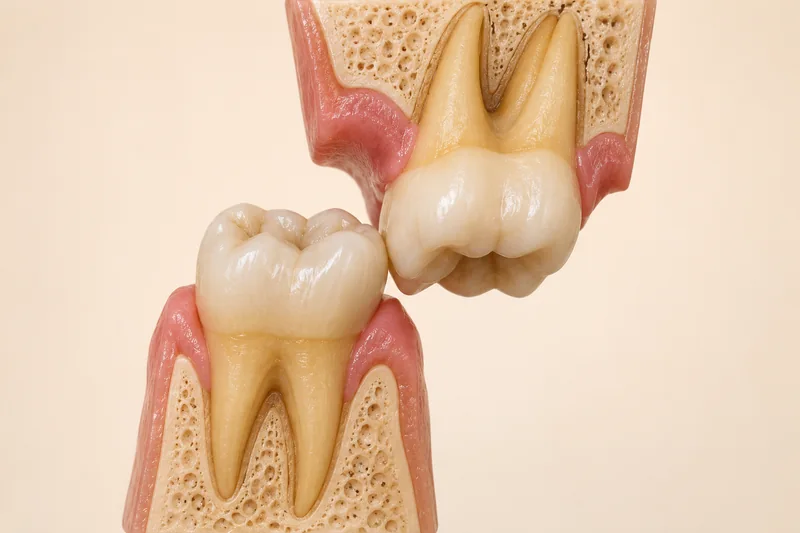
The model shows lateral overlap. Normal chewing contacts can be absent in the affected area.
A tilted individual tooth needs different planning from a substantial width discrepancy. Both sides are assessed.
Age, growth, tissues and bite determine the approach. A photograph alone cannot select an appliance.
Back teeth do not meet normally side to side.
Tooth position, jaw width and function.
Plan after individual bite assessment.
Three steps. No audio.
Each scene can also be selected manually.

Silent educational film with German on-screen text and simplified teaching images. Not a patient case or a promised treatment outcome. The full English explanation is available as text.
A scissor bite is not simply a large forward gap between the incisors.
No. The terms describe different transverse relationships; the actual position matters.
That does not replace assessment. Do not try self-prescribed elastics or exercises to correct the bite.
No. It depends on the findings; the term does not automatically imply surgery.
Editorially suggested question to discuss with Dr Niusha Barahmand Pour:
Which structures account for the missing bite contacts?
Do your teeth noticeably pass beside each other when chewing? Have the contacts examined.
Have bite contacts checkedAppointment selection at DoctolibA scissor bite is not simply a large forward gap between the incisors.
Editorial research: . General information, not an individual diagnosis or treatment recommendation. Teaching illustrations are simplified and do not depict a patient case.