What does secondary caries mean?
Decay in the tooth structure directly at the margin of a filling or another restoration.

Secondary caries is decay directly next to an existing filling or other restoration. It affects the tooth structure, not the filling material. A dark line at the margin alone does not prove it is present.
For dental trainees & teams
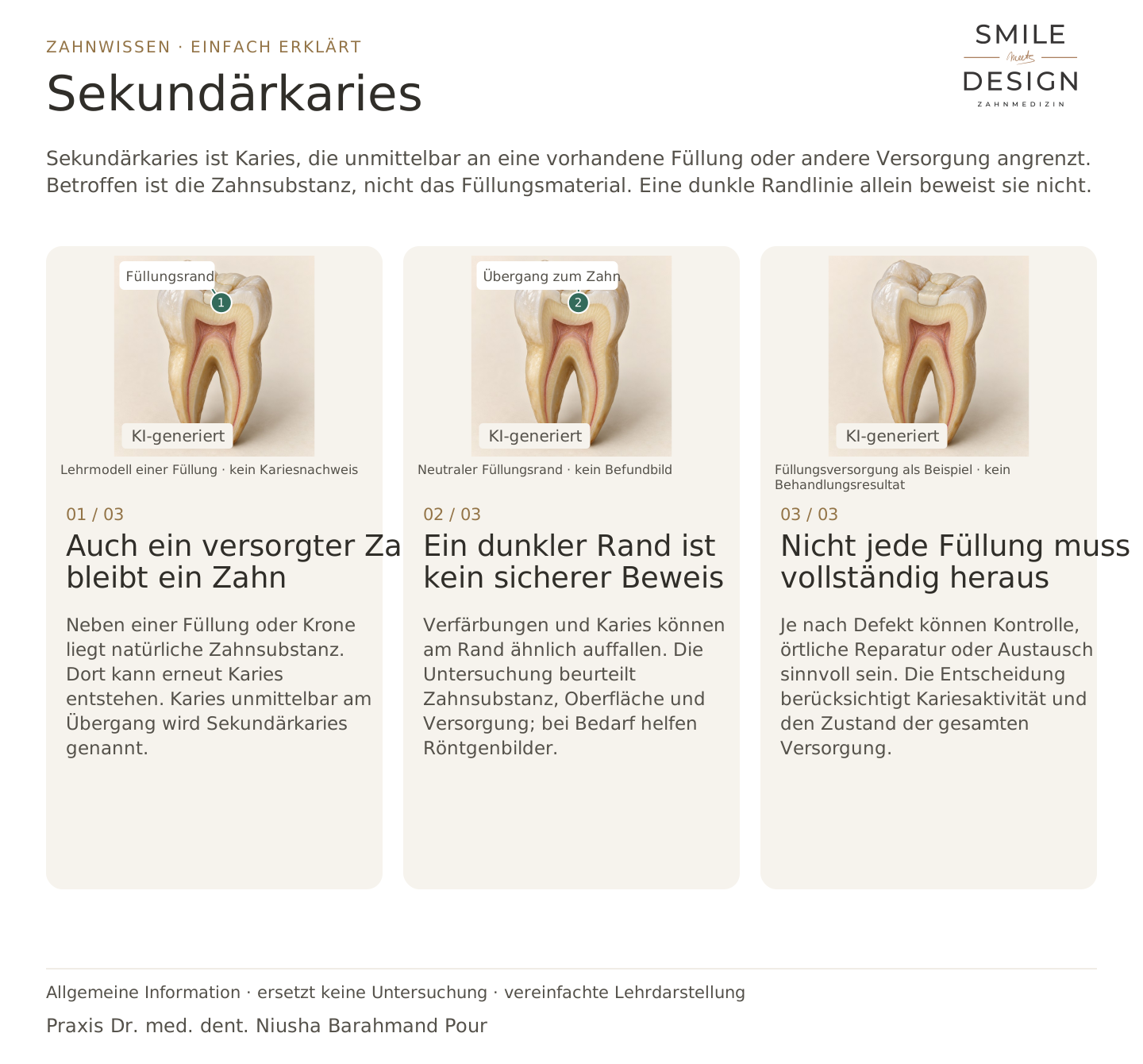
Natural tooth structure lies next to a filling or crown. New decay can develop there. Decay directly at the junction is called secondary caries.
Staining and decay may look similar at a margin. The examination assesses tooth structure, the surface and the restoration; X-rays can help if needed.
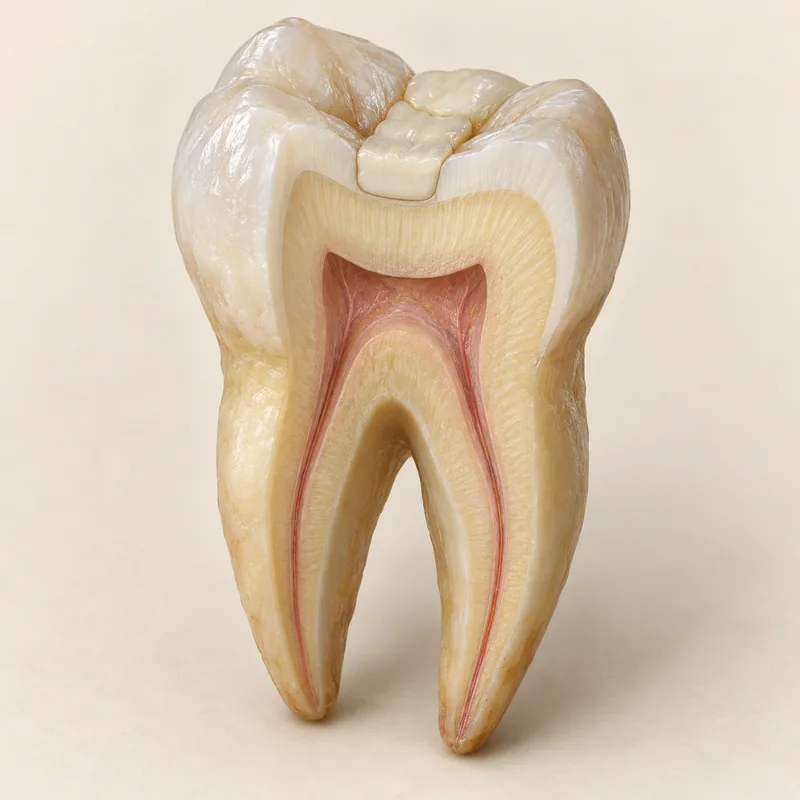
Depending on the defect, monitoring, a local repair or replacement may be appropriate. The decision considers decay activity and the condition of the entire restoration.
Decay in the tooth structure directly at the margin of a filling or another restoration.
Deposits and decay can also develop at these junctions.
By itself, it does not prove decay or justify complete replacement.
Three steps. Straight to the point.
Explanations are also shown on screen.

Silent film in German · English explanations in the three views above
Secondary caries means decay in the adjacent tooth structure. Staining initially describes only the colour at the margin.
No. Decay affects the natural tooth structure at the junction with the restoration.
No. A stained margin without decay in the tooth structure is not secondary caries. An examination establishes whether treatment is needed.
Not necessarily. Depending on the extent and condition, a limited repair may be enough; other findings require replacement.
A question to discuss with Dr. med. dent. Niusha Barahmand Pour:
Is the margin only stained, or is there a defect that should be treated?
Tooth preservation and assessment of the remaining tooth structure are foundations of the practice's restorative planning.
We can examine filling margins that concern you and discuss the next steps.
Have a filling margin assessedChoose an appointment on DoctolibBuild on the simple explanation with clinical terms, key distinctions and a knowledge question.
Not every flaw in a restoration is decay. Colour, defects in the material and decayed tooth structure are assessed separately.
Editorial research: 23 October 2026. This explanation covers general principles and does not replace a personal examination. Suitable treatment is discussed following individual assessment.