Usually bilateral?
Yes, but distribution alone proves nothing.

Sialadenosis is a persistent enlargement of salivary glands that is neither inflammatory nor caused by a tumour, most often affecting the parotid glands. It is commonly bilateral and minimally painful. Diagnosis requires assessment for other causes of swelling.
For training & practice ↓
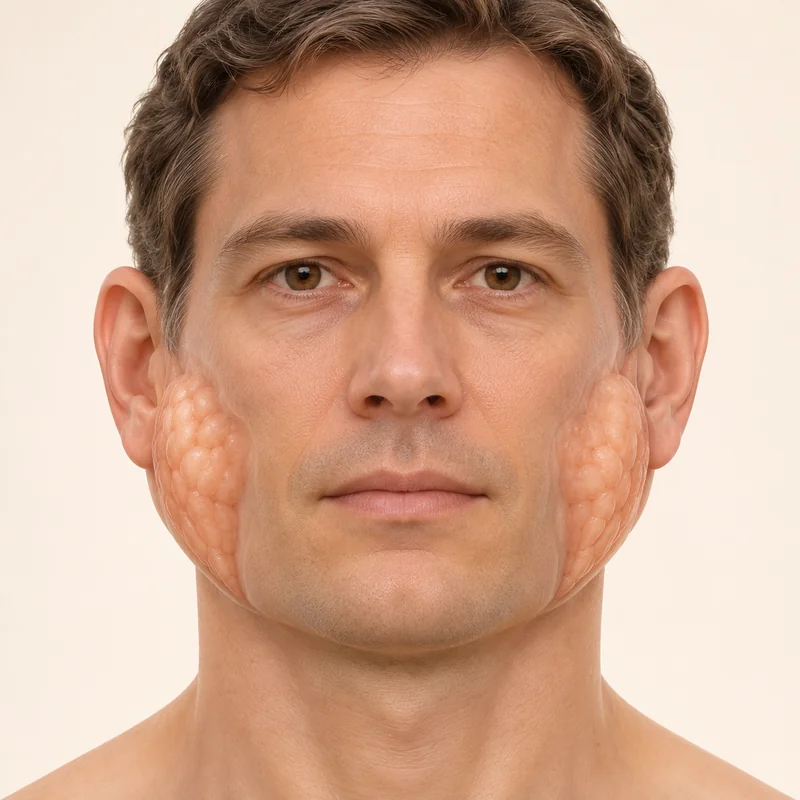
Swelling commonly lies in front of and below the ears. Diffuse enlargement differs from a focal lump; appearance alone cannot establish the cause.
Metabolic or nutritional disorders and medicines can be involved. History and examination, often supplemented by ultrasound, help distinguish the causes.
If an underlying disorder is identified, management also addresses it. Further steps depend on progress; surgery or antibiotics are not automatic requirements.
Yes, but distribution alone proves nothing.
No; other causes still need consideration.
Only after medical advice.
Three steps. No audio.
Each scene can also be selected manually.

Silent educational film with German on-screen text and simplified teaching images. Not a patient case or a promised treatment outcome. The full English explanation is available as text.
Sialadenosis describes gland enlargement. This does not reliably establish excessive or reduced saliva production.
No. Sialadenitis is a different condition. Both can cause swelling and must be distinguished.
No. There are various possible associations; a facial appearance cannot establish the cause.
New or persistent gland swelling needs assessment, particularly a one-sided lump, pain or rapid change.
You can bring this question to your appointment:
Which causes have been excluded, and should an underlying condition be investigated?
An examination can clarify the finding and any need for referral.
Arrange an assessmentAppointment selection at DoctolibSialadenosis describes gland enlargement. This does not reliably establish excessive or reduced saliva production.
Editorial research: . General information, not an individual diagnosis or treatment recommendation. Teaching illustrations are simplified and do not depict a patient case.