Who is this explanation for?
People with swelling or pain near the cheek, jaw or floor of the mouth.

Salivary gland inflammation affects tissue in a gland that produces saliva. The clinical term is sialadenitis. Causes include infections and problems with saliva drainage; a swelling near the cheek or lower jaw is therefore not always caused by a tooth.
For training & practice ↓
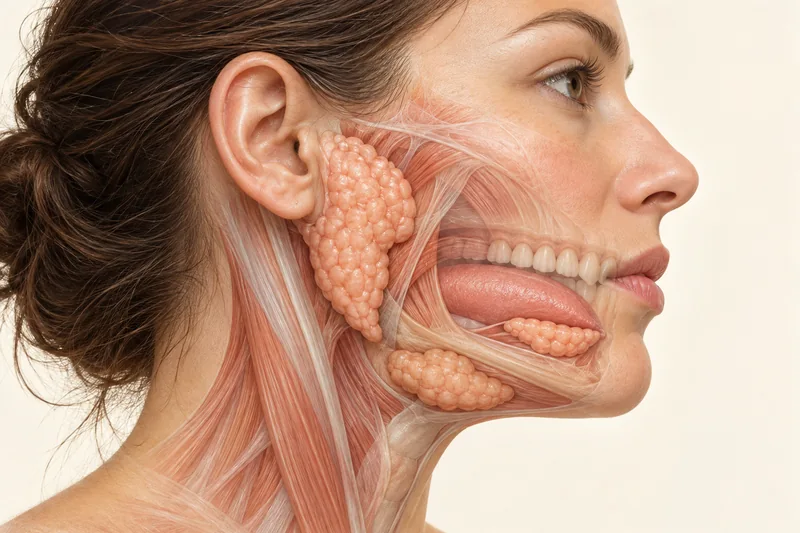
Major salivary glands sit in front of the ears, below the lower jaw and under the tongue. The affected gland influences where swelling becomes noticeable.
Bacteria, viruses or other conditions may be involved. Saliva retained behind an obstruction can also promote infection. Symptoms and an examination help distinguish these possibilities.
Further tests and ENT assessment may be appropriate. Treatment follows the cause. Breathing or swallowing difficulty and rapidly spreading swelling require immediate medical help.
People with swelling or pain near the cheek, jaw or floor of the mouth.
Onset, course, relation to meals, fever, dry mouth, known conditions and medications.
Depending on the cause, dentistry, primary medical care and ENT may be involved.
Three steps. No audio.
Each scene can also be selected manually.

Silent educational film with German on-screen text and simplified teaching images. Not a patient case or a promised treatment outcome. The full English explanation is available below.
Major salivary glands sit in front of the ears, below the lower jaw and under the tongue. The affected gland influences where swelling becomes noticeable.
Bacteria, viruses or other conditions may be involved. Saliva retained behind an obstruction can also promote infection. Symptoms and an examination help distinguish these possibilities.
Further tests and ENT assessment may be appropriate. Treatment follows the cause. Breathing or swallowing difficulty and rapidly spreading swelling require immediate medical help.
Sialadenitis affects a salivary gland. A dental abscess is a pus-forming infection around a tooth or its supporting tissues. Symptoms may overlap, so examination is needed to identify the source.
No. Antibiotics target bacteria and do not treat a purely viral cause. Whether they are needed is decided by the treating clinician after assessment.
No. A stone can obstruct a duct and contribute to inflammation, but a gland can become inflamed without a stone.
For fever, worsening swelling, a pus-like taste or significant pain, contact a medical or dental service promptly. Breathing or swallowing difficulty requires immediate help.
An editorially suggested question for a discussion with Dr med dent Niusha Barahmand Pour:
Is a tooth or a salivary gland more likely to be involved, and which service should investigate further?
Unexplained swelling around the jaw needs assessment. Call directly for acute symptoms; seek immediate medical help for breathing or swallowing difficulty.
Call the practice · 0221 669 401 80Telephone contactSialadenitis affects a salivary gland. A dental abscess is a pus-forming infection around a tooth or its supporting tissues. Symptoms may overlap, so examination is needed to identify the source.
Editorial research: . General information, not an individual diagnosis or treatment recommendation. Teaching illustrations are simplified and do not depict a patient case.