Does it make all the saliva?
Gland tissue produces the secretion.

A salivary duct is a tubular pathway carrying saliva from a gland into the mouth. It differs from the gland tissue that produces the secretion. Duct openings vary: some lie in the cheek, others in the floor of the mouth. Narrowing or a stone can obstruct flow, but simply seeing a normal duct opening is not a sign of disease.
For training & practice ↓
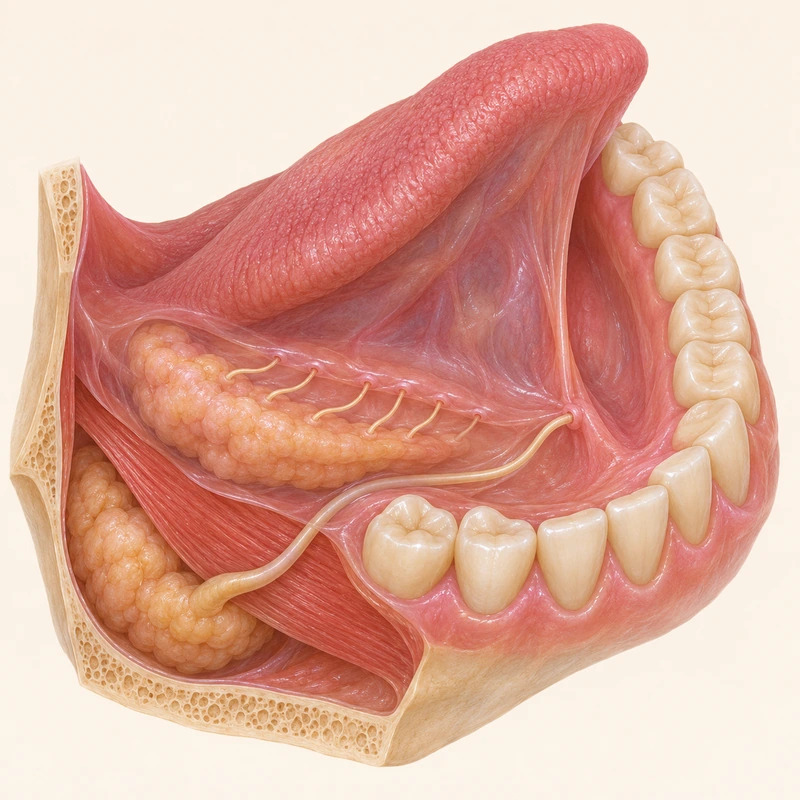
Gland tissue produces saliva; a duct carries it to the mouth surface. The pathway can branch and is not the whole gland.
The parotid duct opens in the cheek near the upper second molar. Other salivary ducts open beneath the tongue.
Swelling or pain can suggest impaired drainage. Do not probe the opening with tools yourself.
Gland tissue produces the secretion.
The site depends on the gland.
No.
Three steps. No audio.
Each scene can also be selected manually.

Silent educational film with German on-screen text and simplified teaching images. Not a patient case or a promised treatment outcome. The full English explanation is available as text.
A gland produces the secretion; a duct transports it. A duct problem and a disorder of gland tissue are not identical.
No. Major glands have larger ducts; minor glands and the sublingual gland also have numerous small outlets. Individual variations occur.
Stensen’s duct is the main parotid duct. Wharton’s duct is the main submandibular duct and opens in the floor of the mouth.
No. Flow varies, and one observation cannot establish a diagnosis. Symptoms and examination matter.
Yes. Narrowing can also impair flow. Pain or swelling should be assessed; further medical investigation may be needed depending on the findings.
Not automatically. A normal salivary opening is an anatomical structure. A tract caused by inflammation is different and must be assessed in context.
You can bring this question to your appointment:
Which gland and duct are involved, and is specialist assessment needed?
A dental examination can clarify how this relates to your findings and treatment planning.
Discuss your dental findingsAppointment selection at DoctolibA gland produces the secretion; a duct transports it. A duct problem and a disorder of gland tissue are not identical.
Editorial research: . General information, not an individual diagnosis or treatment recommendation. Teaching illustrations are simplified and do not depict a patient case.
If you turn this on, this website stores which guides you open, separately from advertising preferences. The markers expire after a fixed 30-day period from activation. The list is not sent to us by this feature. You can turn it off here and delete the markers.
Other people using the same browser profile can also see the markers. German and English versions share one marker. Expired entries are removed the next time you open a page with this feature; deleting browser data may remove them earlier. “Viewed” means opened, not read or completed.