Purpose?
Restore extensive defects in selected primary molars.

A stainless-steel crown is a preformed metal crown that covers a primary molar. It may be appropriate for extensive damage or after certain pulp treatments. The aim is to preserve function until natural replacement where possible; suitability depends on the findings.
For training & practice ↓
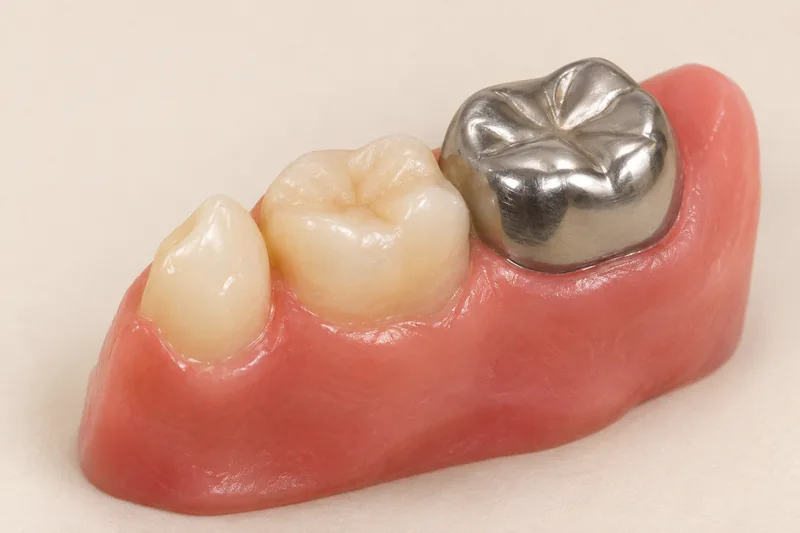
A crown covers the remaining tooth crown, unlike a filling that replaces a more limited defect.
Conventional placement and the Hall technique are different methods. The Hall technique is suitable only for appropriately selected primary teeth.
A crowned primary tooth still needs brushing and review. Pain, swelling or a loose crown needs assessment.
Restore extensive defects in selected primary molars.
No, the method follows the findings.
Care and review through natural replacement.
Three steps. No audio.
Each scene can also be selected manually.

Silent educational film with German on-screen text and simplified teaching images. Not a patient case or a promised treatment outcome. The full English explanation is available as text.
The steel crown sits on the existing primary tooth. It does not replace a root.
A primary molar may still be needed for some time. Pain, infection, chewing and space for the successor are considered.
In selected cases it is used without conventional caries removal or tooth preparation. This does not mean every deep or painful cavity is suitable.
No. Planning for a primary tooth also considers natural tooth replacement.
Editorially suggested question to discuss with Dr Niusha Barahmand Pour:
Which restoration makes sense for this tooth until natural replacement?
Extensive primary-tooth damage needs timely assessment of treatment and whether paediatric dental input is appropriate.
Discuss primary-tooth damageAppointment selection at DoctolibThe steel crown sits on the existing primary tooth. It does not replace a root.
Editorial research: . General information, not an individual diagnosis or treatment recommendation. Teaching illustrations are simplified and do not depict a patient case.