Basic shape?
A distinct ledge.

A shoulder preparation has a distinct ledge at the edge of the prepared tooth. In cross-section, the shoulder surface meets the external axial tooth surface at approximately a right angle. The internal angle may be rounded. This finish-line design provides a defined area for the restoration margin; suitability depends on the tooth, material and restoration.
For training & practice ↓
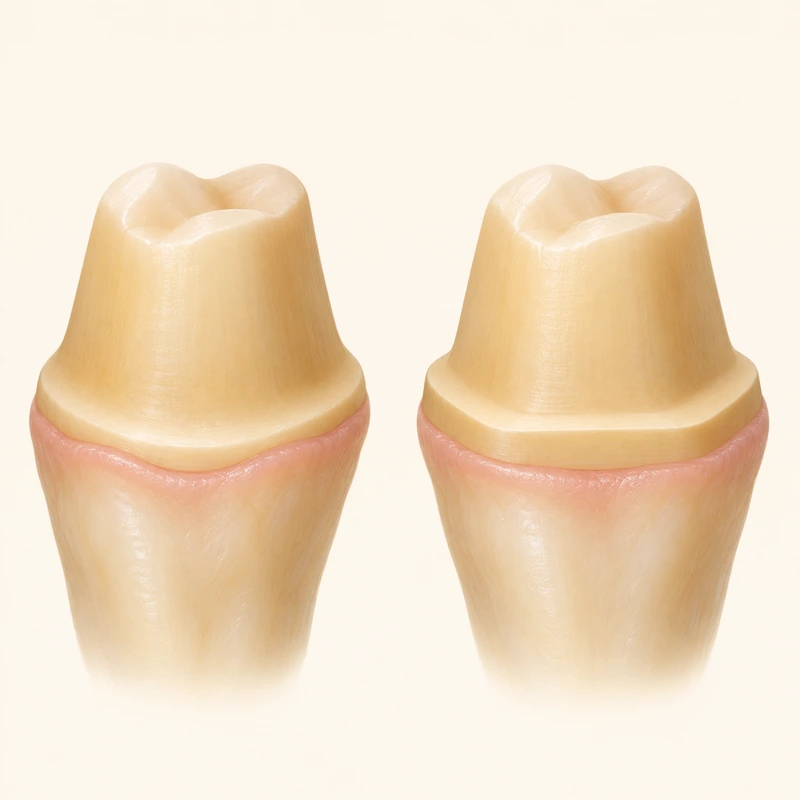
A shoulder creates a distinct ledge at the boundary of the prepared tooth. This tooth-side boundary is separate from the margin of the finished crown.
A shoulder may have a rounded internal angle. It remains a shoulder; not every curved transition makes a margin a chamfer.
Finish-line shape, material requirements and remaining tooth structure belong together. A shoulder is neither automatically better nor required for every restoration.
A distinct ledge.
No; it may be rounded.
No; the restoration determines the requirements.
Three steps. No audio.
Each scene can also be selected manually.

Silent educational film with German on-screen text and simplified teaching images. Not a patient case or a promised treatment outcome. The full English explanation is available as text.
A shoulder has a ledge; a chamfer has a concave transition. Rounding a shoulder’s internal angle does not remove that distinction.
No. A rounded shoulder has a curved internal transition. The distinct ledge still separates it from a concave chamfer.
The actual amount depends on the dimensions and the rest of the preparation. The name alone does not quantify reduction.
No. Ceramics are not one uniform material with a single margin requirement. The chosen construction and its material requirements guide preparation.
It has an additional bevel at the outer edge of the shoulder. This is a distinct variant and is not the same as simply rounding the internal angle.
Yes. Finish-line shape and height relative to the gum are separate features. Location is planned around the findings.
You can bring this question to your appointment:
Which finish-line shape suits the planned restoration, and how much natural tooth structure can be retained?
A dental examination can clarify how this relates to your findings and treatment planning.
Discuss your dental findingsAppointment selection at DoctolibA shoulder has a ledge; a chamfer has a concave transition. Rounding a shoulder’s internal angle does not remove that distinction.
Editorial research: . General information, not an individual diagnosis or treatment recommendation. Teaching illustrations are simplified and do not depict a patient case.
If you turn this on, this website stores which guides you open, separately from advertising preferences. The markers expire after a fixed 30-day period from activation. The list is not sent to us by this feature. You can turn it off here and delete the markers.
Other people using the same browser profile can also see the markers. German and English versions share one marker. Expired entries are removed the next time you open a page with this feature; deleting browser data may remove them earlier. “Viewed” means opened, not read or completed.