
Dental insights · Dental restorations
Inlay, partial crown or crown: what does my tooth need?
A large filling needs replacing, part of a tooth has broken off or an existing restoration no longer provides enough support. Terms such as inlay, partial crown or crown may then come up. These names describe different ways to rebuild an existing tooth. The key question is: how much healthy, load-bearing tooth structure remains?
Editorial review:
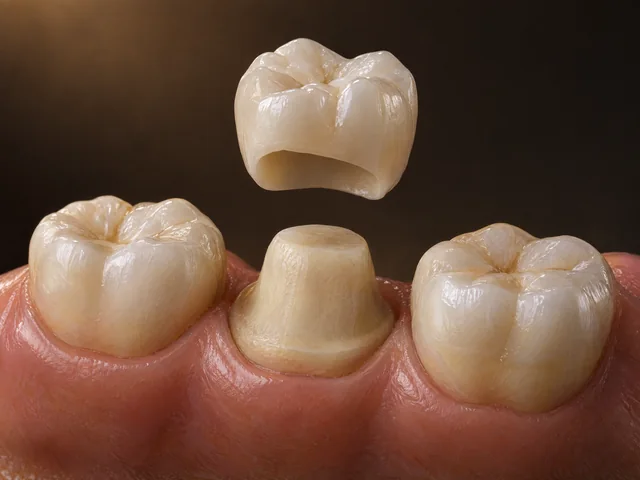 AI-generated
01 An inlay restores a limited area
An inlay is an individually made indirect filling. It is produced outside the tooth and then fitted precisely into place. Typical materials include ceramic or gold alloys. Unlike a filling shaped directly in the mouth, an inlay is made from an impression or a digital data set.
Enough tooth structure must remain to withstand chewing forces. If a restoration extends over the cusps, you may also hear terms such as onlay or overlay. The terminology can vary depending on the extent of the restoration. Ask to be shown on your own tooth which area will be restored and which will be covered. KZBV: Einlagefüllungen
02 A partial crown covers part of the tooth
A partial crown restores a larger section of the visible tooth crown without covering the whole tooth. It may be an option, for example, when some areas are no longer sufficiently strong but others can be preserved. A full crown, by contrast, surrounds the prepared tooth more extensively. Both are attached to the existing tooth; its own root remains in place. IQWiG: Arten von Zahnersatz
A crown therefore does not automatically mean the whole tooth is removed and replaced. This distinction often makes planning clearer: the aim here is to rebuild an existing tooth. An implant serves a different purpose, replacing a missing tooth root.
03 Size alone does not tell the whole story
Two teeth may look similar in a photograph yet need different restorations. The tooth’s condition is decisive in planning, not a hierarchy from “simple” to “especially high quality”. A larger restoration is not better simply because it is larger. For inlays, the KZBV emphasises the importance of the remaining tooth structure and its ability to withstand loading. KZBV: Einlagefüllungen
An explanation based on the findings is therefore helpful: What is damaged? Which areas should be preserved? Why does the recommended restoration suit this particular tooth? Only then can materials and appearance be meaningfully discussed.
04 Four questions for your consultation
- Can you show me which tooth structure is still strong?
- Why do you recommend an inlay, a partial crown or a full crown?
- Which alternatives are actually suitable for my tooth?
- How do the proposed options differ in terms of the process, care and costs?
You do not need to master the technical terms before your appointment. Aim instead to leave with a clear picture: which part of your tooth can be preserved, which part needs rebuilding and why. If anything is still unclear after the explanation, ask for a sketch or a model. This turns an abstract treatment name into a decision you can understand.
Read more about restoring existing teeth under Inlays and Restorative dentistry.
Sources and further information
General information based on the professional sources listed below. A personal assessment is made during an examination.