File the tooth yourself?
No; arrange dental care.

A traumatic oral ulcer is a break in the mucosa caused by injury, such as a bite, sharp tooth edge or rubbing denture. The irritant must be addressed and healing checked. Not every oral sore is traumatic.
For training & practice ↓
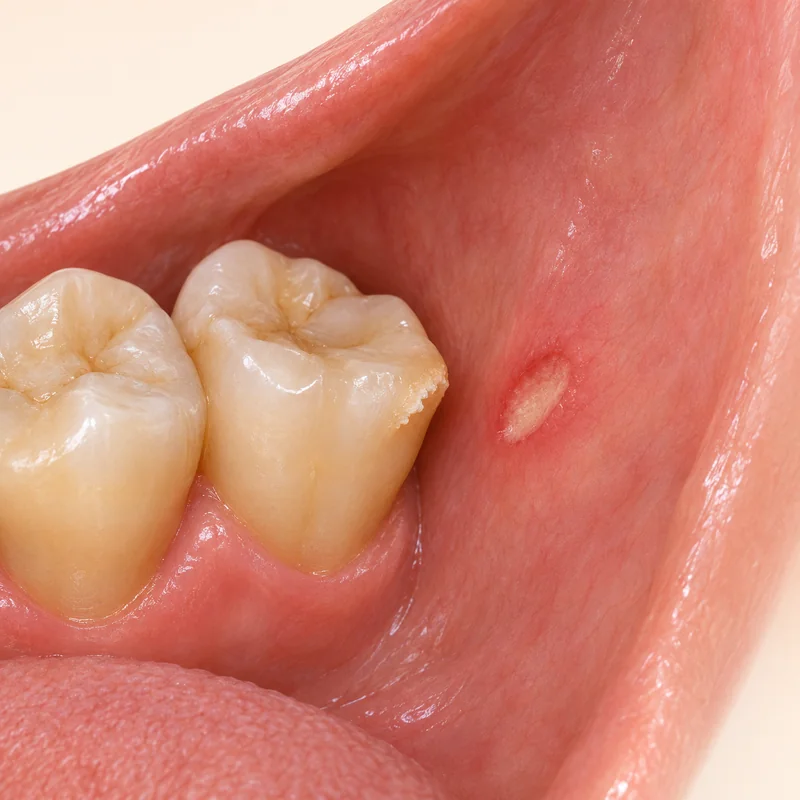
Location and development are compared with biting, tooth edges or appliances. A yellow-white surface can be fibrin and does not prove a pus-producing infection.
Have a sharp tooth or rubbing denture professionally adjusted; do not file it yourself. Soft food and avoiding further irritation can reduce discomfort.
After the cause is removed, the area should heal within about two weeks. If it remains ulcerated or uncertain, further assessment is needed; worsening, bleeding or major functional difficulty warrants earlier review.
No; arrange dental care.
Seek reassessment and further investigation if needed.
Seek help sooner.
Three steps. No audio.
Each scene can also be selected manually.

Silent educational film with German on-screen text and simplified teaching images. Not a patient case or a promised treatment outcome. The full English explanation is available as text.
A non-healing lesion should not indefinitely be labelled a bite injury. Uncertain or suspicious findings may require tissue examination.
No. A specific injury supports a traumatic cause; recurrent aphthous ulcers are a different situation.
No. The lesion must heal even when a possible cause is found. Persistent change needs reassessment.
It may be a wound coating. Do not scrape it or assume antibiotics are needed; the findings and course matter.
You can bring this question to your appointment:
Which irritant is likely, and when will we check that the area has fully healed?
An examination can clarify the finding and any need for referral.
Arrange an assessmentAppointment selection at DoctolibA non-healing lesion should not indefinitely be labelled a bite injury. Uncertain or suspicious findings may require tissue examination.
Editorial research: . General information, not an individual diagnosis or treatment recommendation. Teaching illustrations are simplified and do not depict a patient case.