Does it identify the cause?
No.

Delayed tooth eruption means that a tooth appears in the mouth later than expected from dental development or compared with its counterpart on the other side. This describes an observation, not its cause. Possibilities include individual variation, lack of space, an obstruction or another eruption disorder. Sequence, side-to-side comparison and dental maturity are more informative than one birthday.
For training & practice ↓
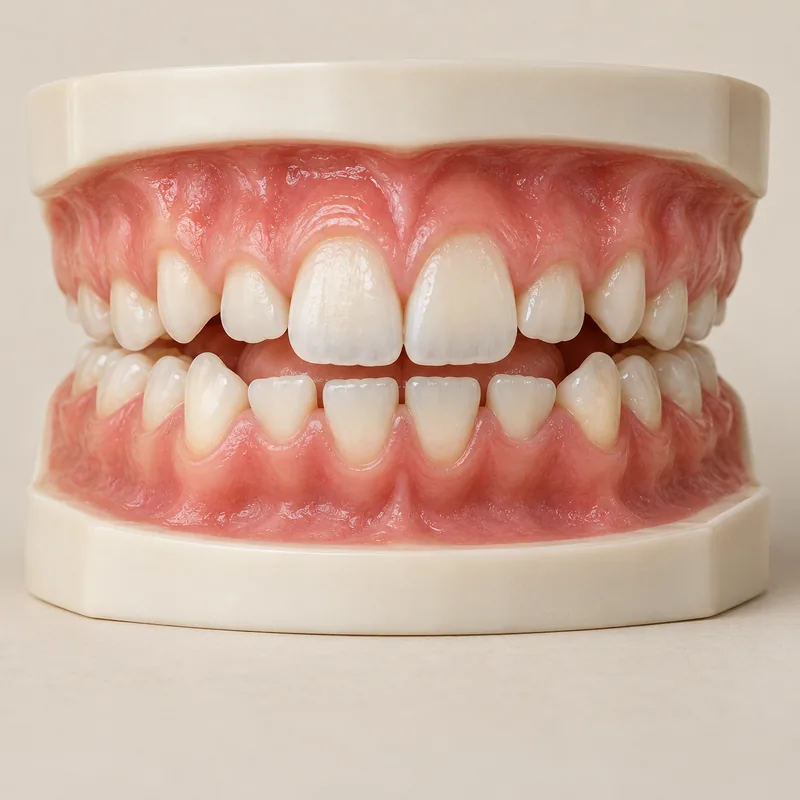
Eruption is assessed over time and between sides. An overall later-developing dentition may mean something different from one tooth lagging behind its counterpart.
Assessment includes space, primary teeth and the position of the successor. An individually justified radiograph may answer a remaining clinical question about an obstruction.
For an upper permanent incisor, a side-to-side delay of more than six months is a reason for assessment. This guide should not be applied indiscriminately to every tooth type.
No.
No; sequence and side differences matter.
No; management depends on the cause.
Three steps. No audio.
Each scene can also be selected manually.

Silent educational film with German on-screen text and simplified teaching images. Not a patient case or a promised treatment outcome. The full English explanation is available as text.
Delay describes timing. Impaction describes failure to erupt normally; lateness alone does not establish a permanent blockage.
No. The tooth may be present but erupt later or along an unfavourable path. A congenitally absent tooth is another possibility; assessment distinguishes these situations.
No. Depending on the cause, monitoring, space management or other measures may be appropriate. Obstruction or a difficult tooth position can require coordinated specialist care.
Do not wait for an age threshold if there is pain, swelling or an unusual change. A clearly abnormal eruption sequence also deserves assessment.
You can bring this question to your appointment:
Is this still a developmental variation, or do the side difference and findings suggest an obstruction?
An individual assessment can clarify the findings and whether referral is needed.
Arrange an assessmentAppointment selection at DoctolibDelay describes timing. Impaction describes failure to erupt normally; lateness alone does not establish a permanent blockage.
Editorial research: . General information, not an individual diagnosis or treatment recommendation. Teaching illustrations are simplified and do not depict a patient case.
If you turn this on, this website stores which guides you open, separately from advertising preferences. The markers expire after a fixed 30-day period from activation. The list is not sent to us by this feature. You can turn it off here and delete the markers.
Other people using the same browser profile can also see the markers. German and English versions share one marker. Expired entries are removed the next time you open a page with this feature; deleting browser data may remove them earlier. “Viewed” means opened, not read or completed.