Only an age issue?
No; the cause matters.

A retained primary tooth remains beyond the expected time of replacement. A missing permanent successor or an eruption problem may be involved. Retention or removal is decided for the individual tooth.
For training & practice ↓
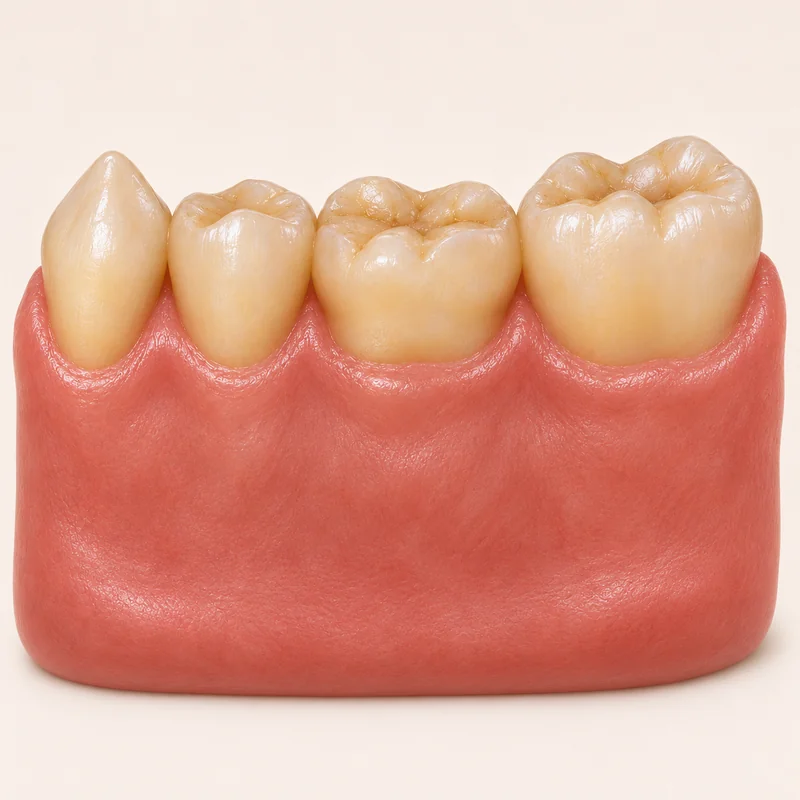
A small tooth is not necessarily a baby tooth. Examination and dental records establish its identity and whether replacement is delayed.
Assessment considers any permanent successor, roots, decay, mobility and height relative to the biting surface. X-rays are selected to answer a specific clinical question.
A suitable primary tooth may remain in use with review. If removal becomes necessary, plan beforehand how the resulting space will be managed.
No; the cause matters.
Arrange an examination.
Depending on the findings and plan.
Three steps. No audio.
Each scene can also be selected manually.

Silent educational film with German on-screen text and simplified teaching images. Not a patient case or a promised treatment outcome. The full English explanation is available as text.
Persistence describes remaining in place. Hypodontia means a tooth failed to develop; ankylosis means fusion between a root and bone. These are different findings.
Not because of age alone. Its condition, function and the overall plan matter.
No. An eruption problem may also be involved.
Its individual lifespan cannot be guaranteed. Regular assessment helps identify changes.
You can bring this question to your appointment:
Is there a permanent successor, and how would any space be managed?
An examination can clarify the finding and any need for referral.
Arrange an assessmentAppointment selection at DoctolibPersistence describes remaining in place. Hypodontia means a tooth failed to develop; ankylosis means fusion between a root and bone. These are different findings.
Editorial research: . General information, not an individual diagnosis or treatment recommendation. Teaching illustrations are simplified and do not depict a patient case.