One core in the canal
The single tapered cone forms the solid core of the filling in the prepared canal.

A gutta-percha cone matched to the prepared canal is placed with a sealer. The cone forms the solid core. Sealer occupies the remaining space at the canal wall.
For training & practice ↓
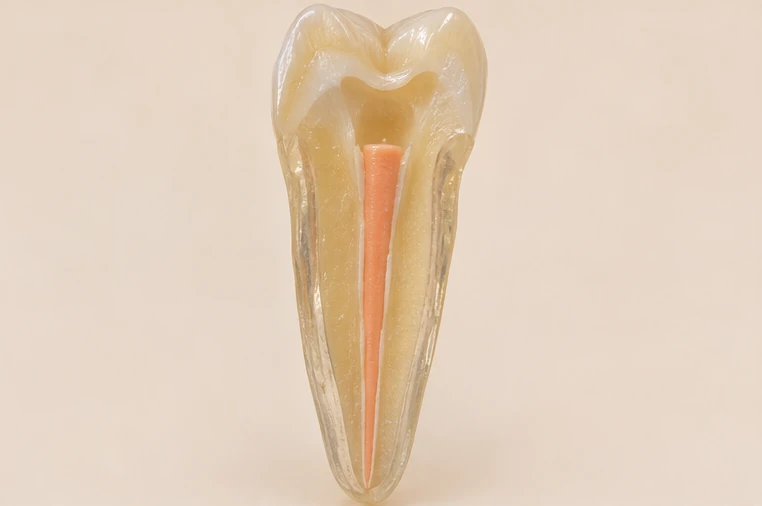
The single tapered cone forms the solid core of the filling in the prepared canal.
The comparison shows several cones side by side as may occur with a different filling method.
A post supporting a restoration is different from a gutta-percha cone.
The single tapered cone forms the solid core of the filling in the prepared canal.
The comparison shows several cones side by side as may occur with a different filling method.
A post supporting a restoration is different from a gutta-percha cone.
The single tapered cone forms the solid core of the filling in the prepared canal.
The comparison shows several cones side by side as may occur with a different filling method.
A post supporting a restoration is different from a gutta-percha cone.
Three steps. No audio.
Each scene can also be selected manually.

Silent film with English on-screen text and simplified teaching images.
The term applies to each treated canal. A multicanal molar may therefore contain several individual master cones.
The term applies to each treated canal. A multicanal molar may therefore contain several individual master cones.
Gutta-percha fills the cleaned root canal. A post and core, if needed to support a restoration, serves a different purpose and is planned separately.
The name alone does not predict the outcome. Anatomy, prior cleaning, sealer and the final coronal seal all matter. Studies often compare a combination of material and technique.
A question to ask
How will the treated canals and the opening in the crown be sealed?
Choose an appointment to discuss your own tooth or restoration.
Choose an appointmentAppointment selection at DoctolibThe master cone and sealer together form the filling. A standard X-ray cannot prove that each microscopic interface is sealed.
Editorial research: . General information, not an individual diagnosis or treatment recommendation. Teaching illustrations are simplified and do not depict a patient case.
If you turn this on, this website stores which guides you open, separately from advertising preferences. The markers expire after a fixed 30-day period from activation. The list is not sent to us by this feature. You can turn it off here and delete the markers.
Other people using the same browser profile can also see the markers. German and English versions share one marker. Expired entries are removed the next time you open a page with this feature; deleting browser data may remove them earlier. “Viewed” means opened, not read or completed.