Origin?
Two developing teeth unite.

Tooth fusion occurs when two developing teeth unite. An unusually broad or divided crown may be a clue. Root and canal anatomy can vary; the outside appearance alone cannot establish the diagnosis.
For training & practice ↓
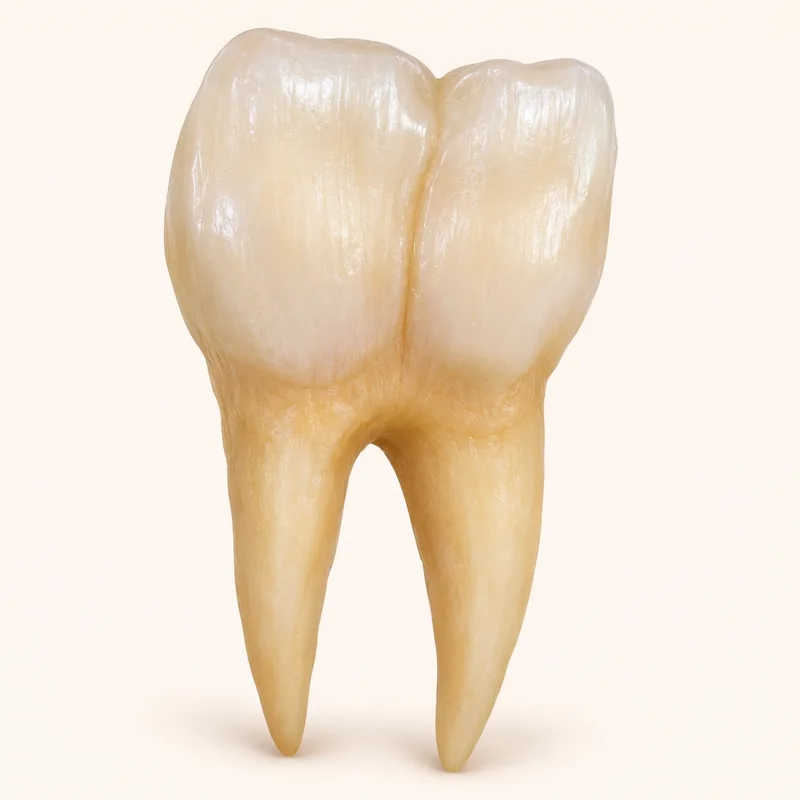
The union develops while the teeth form. It is not the later gluing together of two finished teeth.
A groove at the junction can be difficult to clean. Cavity risk and possible protection are assessed.
Tooth count, successors and internal anatomy are considered together. Not every broad crown needs alteration or separation.
Two developing teeth unite.
A possible groove at the junction.
No, according to function and findings.
Three steps. No audio.
Each scene can also be selected manually.

Silent educational film with German on-screen text and simplified teaching images. Not a patient case or a promised treatment outcome. The full English explanation is available as text.
Fusion joins two developing teeth. Gemination starts from one. Tooth count is a clue, not an infallible test.
The count is often unusual, but fusion with an extra tooth may leave an apparently normal count.
No. Gemination involves attempted division of one developing tooth. Distinguishing them clinically can be difficult.
Clean the groove carefully but gently and ask which tools are appropriate. Do not split or grind it yourself.
Editorially suggested question to discuss with Dr Niusha Barahmand Pour:
How can the groove be protected, and what internal anatomy matters?
A broad crown or deep groove can be assessed for cleanability and developmental variation.
Have tooth shape assessedAppointment selection at DoctolibFusion joins two developing teeth. Gemination starts from one. Tooth count is a clue, not an infallible test.
Editorial research: . General information, not an individual diagnosis or treatment recommendation. Teaching illustrations are simplified and do not depict a patient case.