Timing?
During tooth development.

In tooth gemination, one developing tooth attempts to divide. This may produce a broad crown that appears split. The tooth count is often normal when the double crown is counted as one, but further findings are needed to distinguish fusion.
For training & practice ↓
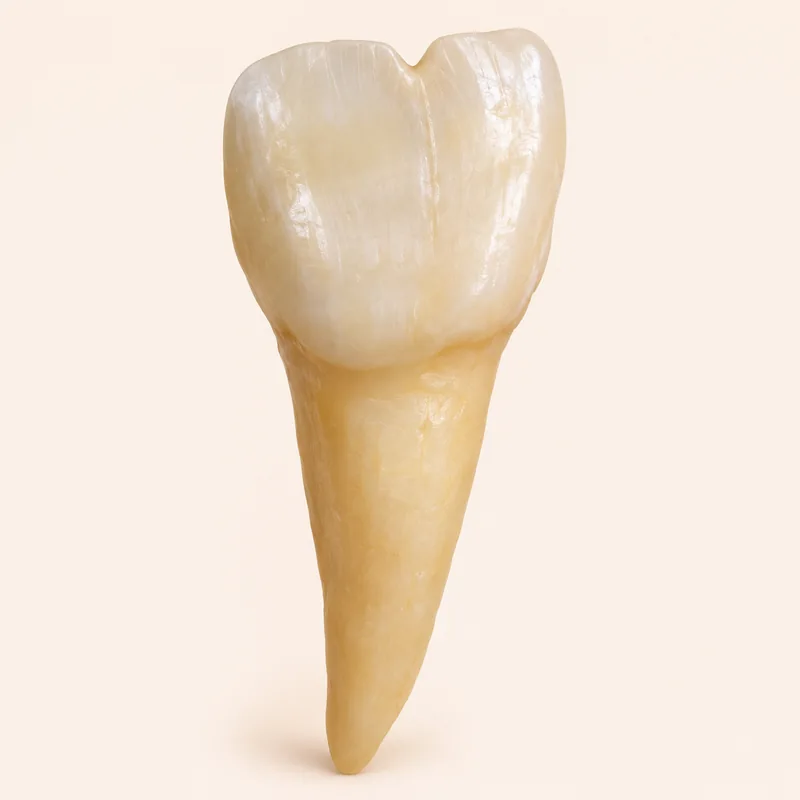
The change forms before eruption. A visible notch does not mean a finished tooth is currently breaking apart.
Crown, root and canal anatomy are assessed together where necessary. A teaching image shows only one possible variant.
A groove or broad crown can affect cleaning or space. Treatment depends on its actual consequences.
During tooth development.
Often normal, but not a stand-alone diagnostic test.
Consider grooves, space and internal anatomy.
Three steps. No audio.
Each scene can also be selected manually.

Silent educational film with German on-screen text and simplified teaching images. Not a patient case or a promised treatment outcome. The full English explanation is available as text.
Gemination starts with one developing tooth; fusion with two. The double-crown appearance alone does not reliably distinguish them.
No. Fusion and other variations may look similar.
Not automatically. Internal anatomy and potential harm must be considered before intervention.
Yes. Eruption and the permanent successor are also considered.
Editorially suggested question to discuss with Dr Niusha Barahmand Pour:
Which variation is present, and how does it affect care and eruption?
An unusually divided crown can be assessed to determine whether cleaning advice or further measures would help.
Have a double crown assessedAppointment selection at DoctolibGemination starts with one developing tooth; fusion with two. The double-crown appearance alone does not reliably distinguish them.
Editorial research: . General information, not an individual diagnosis or treatment recommendation. Teaching illustrations are simplified and do not depict a patient case.