Choosing a handle
An enlarged handle may be easier to hold with limited finger movement. Try different shapes to see which fits.

Hemiparesis means weakness or partial paralysis on one side of the body. Holding a brush, opening a toothpaste tube or reaching the back teeth may become difficult. The aim is to clean both sides of the mouth while doing as many steps independently as possible with support where needed.
For training & practice ↓
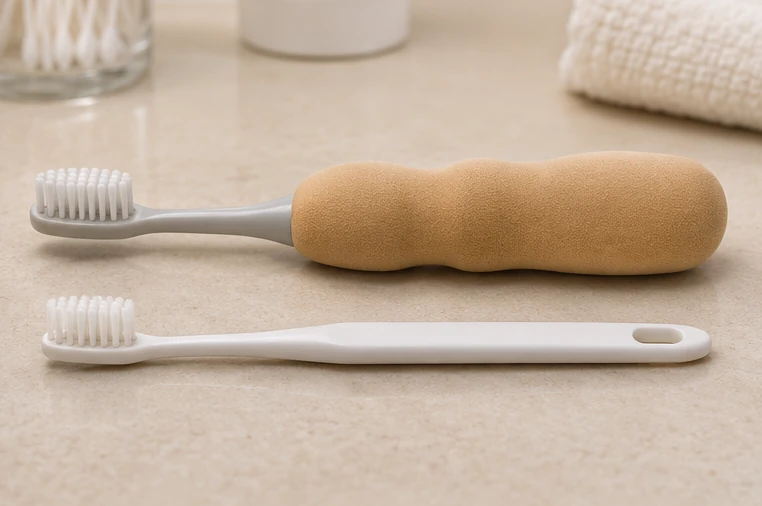
An enlarged handle may be easier to hold with limited finger movement. Try different shapes to see which fits.
The person guides the brush. With permission, a helper can support the movement at the wrist if needed.
Tooth surfaces on the weaker or less attended side also need cleaning. The support required is assessed individually.
Three steps. No audio.
Each scene can also be selected manually.

Silent film with English on-screen text and simplified teaching images.
A thicker handle may be easier to hold. Some people reach tooth surfaces more easily with an electric toothbrush. Work with the rehabilitation or dental team to find which hand, grip size and brush suit you.
A thicker handle may be easier to hold. Some people reach tooth surfaces more easily with an electric toothbrush. Work with the rehabilitation or dental team to find which hand, grip size and brush suit you.
It depends on hand function, awareness and stamina. Setting out supplies, reminding you about the other side or supporting your hand with your permission may be enough. A trained helper can supervise or provide more of the care when needed.
NICE recommends brushing the teeth and gums at least twice daily after stroke. The team should adapt care to any swallowing difficulty. Whether and how you use water or a mouth rinse depends on your individual swallowing plan.
A question to ask
Can we try out a brush and level of assistance suited to my hand function?
When arranging a dental assessment, mention any support you need or an upcoming medical procedure.
Choose an appointmentAppointment selection at DoctolibOne-sided weakness, reduced awareness of one side of the mouth and swallowing impairment are different findings. They can occur together and may need different forms of support. With permission, observe which specific steps require help.
Editorial research: . General information, not an individual diagnosis or treatment recommendation. Teaching illustrations are simplified and do not depict a patient case.
If you turn this on, this website stores which guides you open, separately from advertising preferences. The markers expire after a fixed 30-day period from activation. The list is not sent to us by this feature. You can turn it off here and delete the markers.
Other people using the same browser profile can also see the markers. German and English versions share one marker. Expired entries are removed the next time you open a page with this feature; deleting browser data may remove them earlier. “Viewed” means opened, not read or completed.