
Dental knowledge · Tooth preservation
Front-tooth injuries: first aid after a fall or impact
After a fall or blow to the front teeth, the injured person’s safety comes first. Then arrange dental help immediately, keep broken fragments safe and prevent a completely knocked-out permanent tooth from drying out. Baby teeth must not be put back. These steps help parents, companions and injured people organise what to do next; they cannot determine the severity of an injury.
Published on
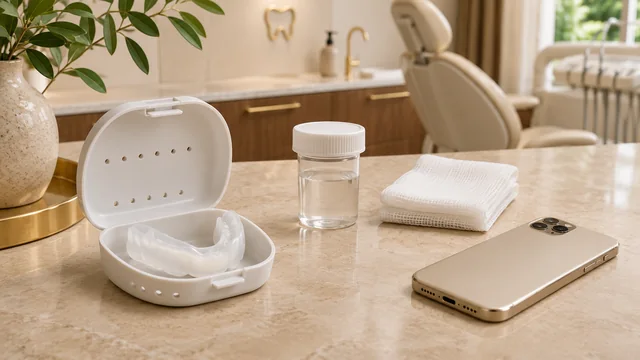 AI-generated
In this guide
Care for the person before the tooth
Is the person responsive and breathing normally? Call 112 for breathing difficulty, unconsciousness, serious facial injuries or heavy persistent bleeding. After a blow to the head, vomiting, unusual drowsiness or double vision are also warning signs requiring immediate medical assessment. If life-threatening injury is possible and you are unsure, call 112.
A second person can look for the tooth or fragment and arrange help. Do not keep a tooth or fragment loose in the mouth of a child or a drowsy person: it could be swallowed or inhaled.
Bundesministerium für Gesundheit: Nummern für den Notfall · NHS: How to find an emergency or urgent NHS dentist appointment; geprüft 14. Mai 2025 · IADT-Leitlinie 2020: Avulsion of permanent teeth, Fouad et al. · IADT-Leitlinie 2020: Injuries in the primary dentition, Day et al. · NHS: Head injury and concussion; geprüft 29. Mai 2025
What can you see?
A piece is missing: collect the fragment and keep it moist in milk or the person’s own saliva in a clean container. A tooth is crooked, looks shorter or is loose: do not straighten or wiggle it yourself; seek dental care immediately. If the whole tooth is out, continue to step 3.
Tell the dental team if a tooth cannot be found after the accident. It may have been knocked out, pushed into the jaw or ended up elsewhere. If a baby tooth thought to have been knocked out cannot be located, medical assessment in an emergency department is also indicated. Coughing, breathing problems or suspected inhalation requires immediate medical help. Searching must not delay treatment.
Universitätsklinikum Bonn: Zentrum für Frontzahntrauma und Sportzahnmedizin – Notfall · IADT/ASD 2024: Guidelines for prevention of traumatic dental injuries, Part 10: First aid education, Tewari et al. · IADT-Leitlinie 2020: Injuries in the primary dentition, Day et al.
Whole tooth knocked out: baby or permanent tooth?
A knocked-out baby tooth must not be reinserted. Doing so could damage the developing permanent tooth, among other risks. A dental examination is still needed. Children in the mixed-dentition stage have baby and permanent teeth at the same time; age alone does not identify the tooth reliably.
For a tooth known to be permanent, immediately putting it back at the accident site is often the best first aid. The person must be awake and cooperative, and insertion must be safe. If you are unsure of the tooth type, or the person is drowsy or uncooperative, do not force anything: keep the tooth moist and obtain dental help immediately.
IADT-Leitlinie 2020: Injuries in the primary dentition, Day et al. · IADT-Leitlinie 2020: Avulsion of permanent teeth, Fouad et al. · NHS: Knocked-out tooth; geprüft 6. Februar 2025
Gently reinsert a permanent tooth — or transport it moist
Hold the tooth only by its white crown, not its root. If dirty, rinse it briefly and gently in milk, saline or the person’s own saliva; do not scrub or disinfect it. If possible, gently return it to its socket in the correct orientation immediately. Do not force it if it does not go in easily.
Once it is back, have the person gently bite on clean gauze or a clean cloth and obtain dental treatment immediately. If it cannot be reinserted, place it straight into tooth-preservation solution or milk. If neither is available, the person’s own saliva in a container or saline can be used. Do not wrap it dry in a tissue or place it on ice. Do not leave it to dry while you go looking for a preservation kit.
IADT/ASD 2024: Guidelines for prevention of traumatic dental injuries, Part 10: First aid education, Tewari et al. · IADT-Leitlinie 2020: Avulsion of permanent teeth, Fouad et al. · NHS: Knocked-out tooth; geprüft 6. Februar 2025
Explain the accident and storage when you call
Say “dental accident” and give the person’s age, when it happened, and whether a tooth is broken, displaced or completely knocked out. Mention any loss of consciousness and how long a knocked-out tooth was dry. Bring the tooth or fragments and, if readily available, a medication list and vaccination record. Missing documents must not delay the journey.
Outside normal opening hours, use the official emergency dental service search provided by the North Rhine dental chamber and call the listed practice before travelling. With a knocked-out tooth, do not wait for a routine online appointment. General appointment booking does not replace acute accident care.
IADT-Leitlinie 2020: Avulsion of permanent teeth, Fouad et al. · IADT-Leitlinie 2020: Injuries in the primary dentition, Day et al. · Zahnärztekammer Nordrhein: Zahnärztlicher Notfalldienst
Why follow-up matters after the first treatment
After a front-tooth injury, assessment may include not only the visible crown but also the root, supporting tissues, soft tissues and neighbouring teeth. Continued root development matters particularly in young permanent teeth. A tooth that initially seems unremarkable may show changes later, so an individual follow-up plan is needed, sometimes over several years.
Report new swelling, pain, looseness or colour changes. A darker baby tooth alone does not establish an infection requiring treatment. The dental team needs to assess the findings. Even appropriate first treatment cannot guarantee the long-term survival of a severely injured tooth.
IADT-Leitlinie 2020: Fractures and luxations, Bourguignon et al. · IADT-Leitlinie 2020: Injuries in the primary dentition, Day et al. · IADT-Leitlinie 2020: Avulsion of permanent teeth, Fouad et al. · DGET: Traumatologie – Leitlinien und Empfehlungen
Common questions
Should I push a displaced tooth back myself?
No. A displaced tooth still in the mouth needs professional assessment and, if appropriate, repositioning. This differs from a completely knocked-out permanent tooth, for which immediate safe replantation is recommended as first aid.
Universitätsklinikum Bonn: Zentrum für Frontzahntrauma und Sportzahnmedizin – Notfall · IADT/ASD 2024: Guidelines for prevention of traumatic dental injuries, Part 10: First aid education, Tewari et al.
A baby tooth is missing, but my child has little pain. Is watching enough?
Have the accident assessed by a dentist. The missing tooth needs to be accounted for, and soft tissues or the developing permanent tooth may be affected. If a baby tooth thought to have been knocked out cannot be found, medical assessment in an emergency department is also needed. Do not put a completely knocked-out baby tooth back.
IADT-Leitlinie 2020: Injuries in the primary dentition, Day et al.
Is a tooth beyond saving if it has been dry for a while?
Time spent dry worsens the outlook, but is not a reason to throw the tooth away. Bring it and report the timings as accurately as possible. Examination will determine whether and how it can be treated.
IADT-Leitlinie 2020: Avulsion of permanent teeth, Fouad et al.
Does every front-tooth injury need root canal treatment?
No. The injury type and the tooth’s stage of development matter. In some injuries the pulp can be preserved; in others root canal treatment is needed. One test immediately after the accident may not be enough to decide.
IADT-Leitlinie 2020: Fractures and luxations, Bourguignon et al. · DGET: Traumatologie – Leitlinien und Empfehlungen
Related reading
Sources and further reading
Research and editorial date: 7 November 2026. General information; individual findings and recommendations require an examination.
- IADT/ASD 2024: Guidelines for prevention of traumatic dental injuries, Part 10: First aid education, Tewari et al.
- IADT-Leitlinie 2020: Avulsion of permanent teeth, Fouad et al.
- IADT-Leitlinie 2020: Injuries in the primary dentition, Day et al.
- IADT-Leitlinie 2020: Fractures and luxations, Bourguignon et al.
- NHS: Knocked-out tooth; geprüft 6. Februar 2025
- Universitätsklinikum Bonn: Zentrum für Frontzahntrauma und Sportzahnmedizin – Notfall
- NHS: How to find an emergency or urgent NHS dentist appointment; geprüft 14. Mai 2025
- Bundesministerium für Gesundheit: Nummern für den Notfall
- Zahnärztekammer Nordrhein: Zahnärztlicher Notfalldienst
- DGET: Traumatologie – Leitlinien und Empfehlungen
- NHS: Head injury and concussion; geprüft 29. Mai 2025