
Dental knowledge · Did you know?
Why does the dentist test a tooth with cold?
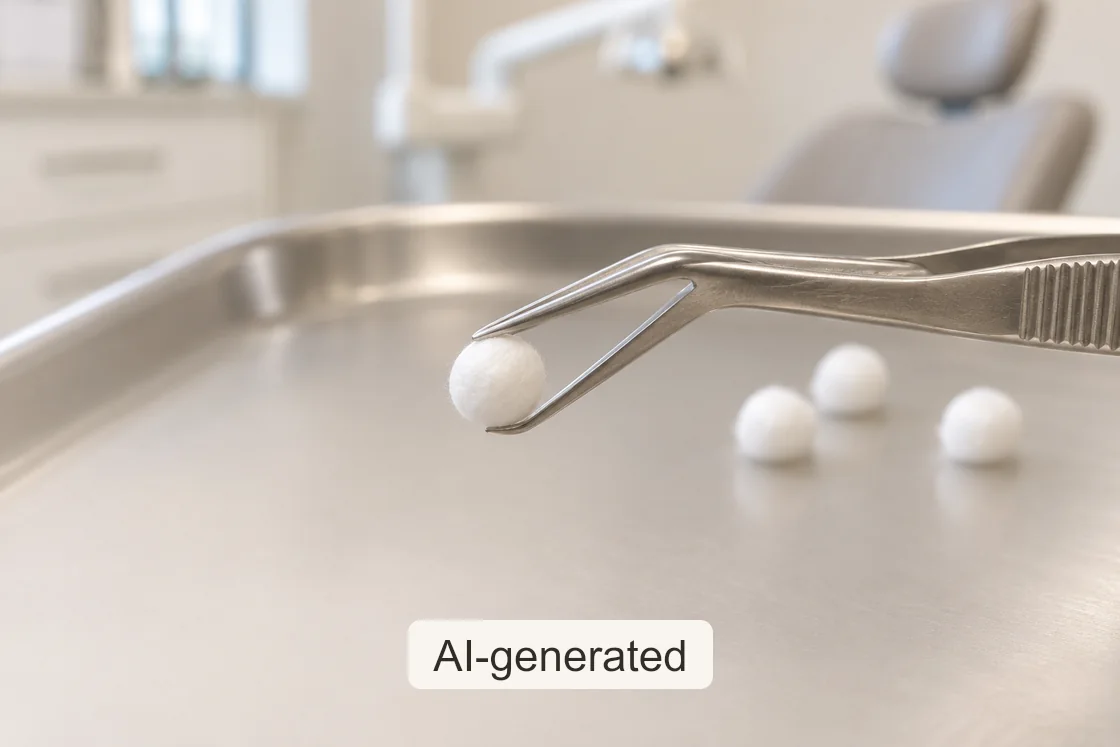
The dentist uses a small chilled cotton pellet to check whether the nerves inside a tooth respond to cold. What matters is what you feel. Does it feel much the same as on a tooth that hasn't been bothering you? Does the sensation stop when the cotton comes away? Both observations help the dentist investigate your symptoms.
Published on
In this guide
Why start with a different tooth?
You may only be able to point to the general area that hurts. Testing one tooth at a time can help narrow it down. The dentist often starts with a neighbouring tooth that seems healthy or the matching tooth on the other side. You get a sense of what to expect, and the dentist learns what a usual response feels like for you.
Next comes the tooth in question. The dentist dries its surface and briefly touches it with the chilled cotton. This test involves no drilling or injection.
When should I raise my hand?
Agree on a signal beforehand. If the dentist asks you to raise your hand at the first sensation, do so as soon as you feel the cold. You don't have to wait for it to hurt to give a useful answer. Then say when the feeling has gone. If you're unsure what you felt, you can say that too.
Describe the difference in your own words. “Much stronger than on the other side, but it went away straight away” tells the dentist something different from “The cotton is gone, but it still hurts.” It also helps to say whether the test brought on the same pain you've felt at home.
A brief twinge, lingering pain or no response
A brief twinge that fades once the cotton is removed can be a usual response. The dentist will examine the tooth further to work out whether symptoms come from decay, a sensitive area near the gumline or another cause. It also matters whether the tooth feels comfortable at other times.
Pain that continues after the cold is removed can be a sign of inflammation in the pulp. The pulp is the soft tissue inside the tooth that contains nerves and blood vessels. How long the pain lasts helps the dentist interpret it. No single time limit determines which treatment your tooth needs.
If you feel nothing, one possibility is that the pulp has died. Cold tests the nerve response and gives no direct measure of blood flow to the pulp. The dentist therefore needs other evidence before drawing a conclusion from an absent response.
What changes after a blow to a tooth?
After a fall, a permanent front tooth may temporarily stop responding to cold even though its pulp still has a blood supply. Tell the dentist about any earlier injury. If you've just injured a tooth, have a dentist check it promptly.
At follow-up visits, the dentist can compare the response with the first test. Your symptoms, the examination and an X-ray when needed help show how the tooth is doing after the injury. At the first visit, ask when you should come back.
What determines the next step?
Several findings help determine whether a tooth needs treatment. These include how the pain developed, the condition of the tooth and, for example, whether it is tender when gently tapped. Sometimes an additional electric pulp test helps. The choice of test depends on what the dentist still needs to find out.
“Which tooth responded differently? What else suggests it's the source of my pain?” These are two questions to ask after the test. The answers can help you understand why the dentist suggests treatment, another test or a follow-up visit.
Related reading
Sources and further information
- European Society of Endodontology, S3 clinical practice guideline (2023), recommendation R1.1
- Almutairi and colleagues, clinical study describing sensibility testing on crowned teeth (2021)
- Karrar and colleagues, clinical study of pain history and cold responses in pulpitis (2025)
- International Association of Dental Traumatology, guidelines on injuries to permanent teeth (2020), section 5
- American Association of Endodontists, endodontic examination and the use of comparison teeth (2013)