Are aerosols always visible?
No. Small airborne particles are often not individually visible. Visible spray therefore does not describe the entire exposure.

A dental aerosol consists of small solid or liquid particles suspended in air. These can arise during different dental activities. Their composition and amount depend on the procedure and surroundings; not every particle contains an infectious pathogen.
For training & practice ↓
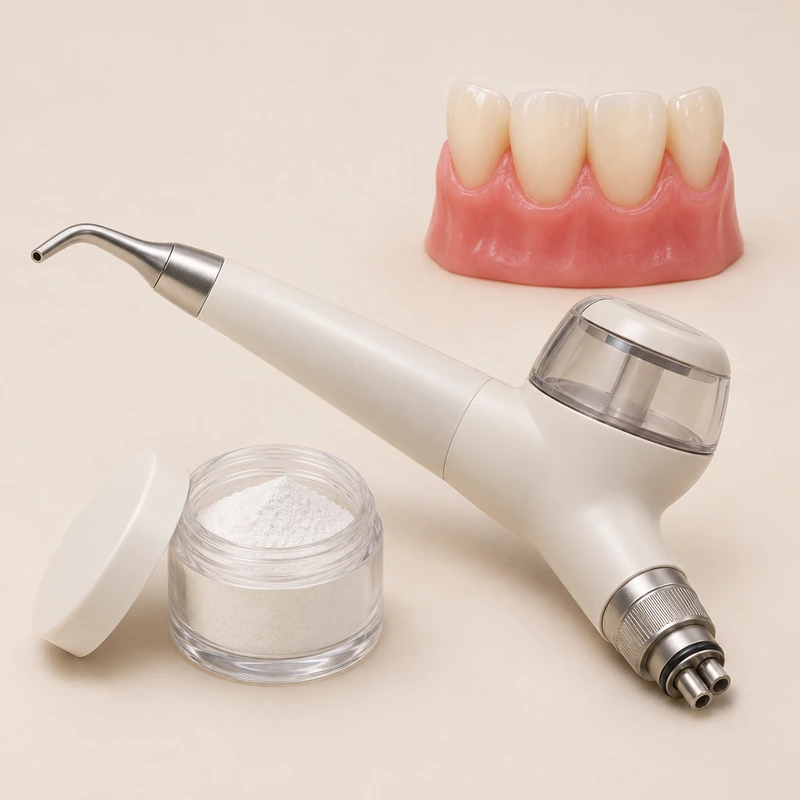
Instruments and processing steps can release particles. Cooling water, treated materials and the surroundings contribute in different ways.
Particle counts, detected microorganisms and actual infection transmission are different measurements.
Appropriate suction can capture particles close to their source. This does not promise completely particle-free treatment.
No. Small airborne particles are often not individually visible. Visible spray therefore does not describe the entire exposure.
This cannot be assumed. Sources and composition vary with the activity, water supply and surroundings.
No. Finding microorganisms in a sample does not automatically establish infectivity or actual transmission to people.
Three steps. No audio.
Each scene can also be selected manually.

Silent educational film with German on-screen text and simplified teaching images. Not a patient case or a promised treatment outcome. The full English explanation is available as text.
Aerosol refers to particles suspended in air; larger splashes behave differently. Transitions depend on size and environmental conditions.
No. Small airborne particles are often not individually visible. Visible spray therefore does not describe the entire exposure.
This cannot be assumed. Sources and composition vary with the activity, water supply and surroundings.
No. Finding microorganisms in a sample does not automatically establish infectivity or actual transmission to people.
It can reduce escaping particles at their source. Its effect depends on application and procedure; it does not by itself establish zero risk.
Not from a single particle study. Procedures, suction and surroundings differ; measured particle distributions do not establish a universal infection boundary.
You can raise this editorially suggested question during your consultation.
Which measures suit my planned procedure and current symptoms?
Which measures suit my planned procedure and current symptoms?
Request a consultationAppointment selection at DoctolibMeasured particle exposure must not be equated with clinically demonstrated infection.
Editorial research: . General information, not an individual diagnosis or treatment recommendation. Teaching illustrations are simplified and do not depict a patient case.
If you turn this on, this website stores which guides you open, separately from advertising preferences. The markers expire after a fixed 30-day period from activation. The list is not sent to us by this feature. You can turn it off here and delete the markers.
Other people using the same browser profile can also see the markers. German and English versions share one marker. Expired entries are removed the next time you open a page with this feature; deleting browser data may remove them earlier. “Viewed” means opened, not read or completed.