What does the stream remove?
Mainly biofilm and external stains.

Dental air polishing uses a directed stream of air, water and cleaning powder to remove soft deposits and external stains. The powder, nozzle and treatment site must be compatible.
For training & practice ↓
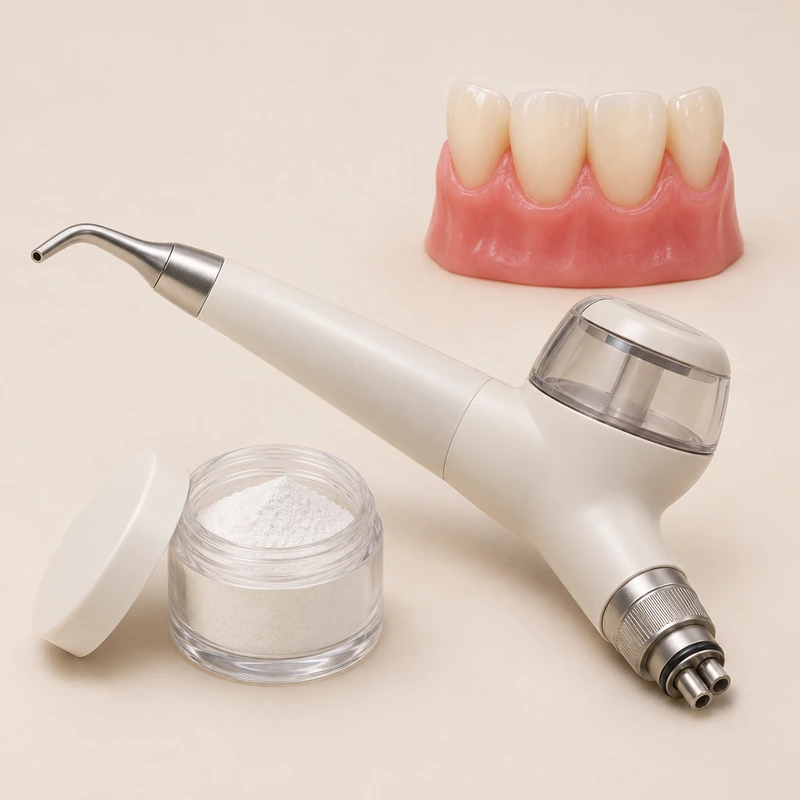
The stream is professionally directed at suitable surfaces. It can remove biofilm and surface stains, but does not change internal tooth colour as bleaching does.
Glycine, erythritol and other powders differ. Exposed roots, restorations and implant surfaces require an appropriate combination of powder, device and application.
Hard deposits may remain after biofilm removal. Suitable hand or powered instruments are used for these. A stain-free appearance alone does not prove treatment is complete.
Mainly biofilm and external stains.
No, AIRFLOW is a brand.
No, dental air polishing requires trained professional use.
Three steps. No audio.
Each scene can also be selected manually.

Silent educational film with German on-screen text and simplified teaching images. Not a patient case or a promised treatment outcome. The full English explanation is available as text.
Removing external stains is different from chemical bleaching.
AIRFLOW is an air-polishing system brand. Air polishing is the general term; systems do not all use the same powders or nozzles.
The method mainly removes biofilm and staining. It does not reliably replace a separate approach to hard calculus removal.
When indicated, with powders and nozzles designed for that purpose. An ordinary tip must not simply be inserted into periodontal pockets.
No. Unsuitable use can harm tissues or surfaces. Rarely, air can enter tissue; sudden swelling needs immediate assessment.
Discuss medical conditions, allergies, sensitive areas, implants and restorations. These and the examination findings guide the choice.
You can bring this question to your appointment:
Which powder is suitable for my tooth surfaces and restorations?
Discuss which cleaning approach fits your findings.
Discuss dental careAppointment selection at DoctolibRemoving external stains is different from chemical bleaching.
Editorial research: . General information, not an individual diagnosis or treatment recommendation. Teaching illustrations are simplified and do not depict a patient case.
If you turn this on, this website stores which guides you open, separately from advertising preferences. The markers expire after a fixed 30-day period from activation. The list is not sent to us by this feature. You can turn it off here and delete the markers.
Other people using the same browser profile can also see the markers. German and English versions share one marker. Expired entries are removed the next time you open a page with this feature; deleting browser data may remove them earlier. “Viewed” means opened, not read or completed.