Does alginate become completely rigid in the mouth?
It forms an elastic gel. Tray choice, removal and sufficient setting still need professional coordination.

Alginate is an elastic impression material in the irreversible hydrocolloid group. After mixing with water, it forms a gel-like negative reproduction of teeth and adjacent structures. This impression can be poured to produce a model.
For training & practice ↓
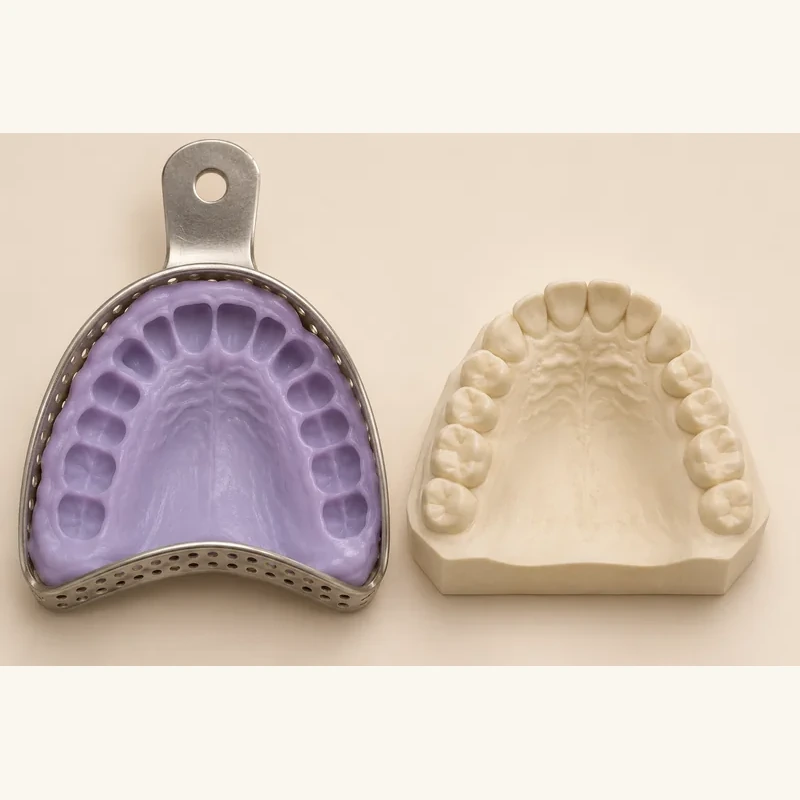
The material records surfaces within an impression tray. The resulting recesses are not yet a positive dental model.
After appropriate cleaning and disinfection, the impression can be poured with a model material.
Alginate impressions cannot be stored arbitrarily. Permitted waiting time and moisture conditions depend on the product.
It forms an elastic gel. Tray choice, removal and sufficient setting still need professional coordination.
The chemical gel formation cannot simply be reversed by heating to reuse the same impression.
No. Alginate provides the negative form; poured dental stone produces the positive model.
Three steps. No audio.
Each scene can also be selected manually.

Silent educational film with German on-screen text and simplified teaching images. Not a patient case or a promised treatment outcome. The full English explanation is available as text.
An impression records the inverse surface form. A model reproduces the tooth form positively.
It forms an elastic gel. Tray choice, removal and sufficient setting still need professional coordination.
The chemical gel formation cannot simply be reversed by heating to reuse the same impression.
No. Alginate provides the negative form; poured dental stone produces the positive model.
That depends on the product and its storage conditions. One storage period cannot reliably apply to every alginate.
Mention known reactions to impression materials or a strong gag reflex so the approach can be planned.
You can raise this editorially suggested question during your consultation.
Which impression method suits my treatment goal and any gag reflex?
Which impression method suits my treatment goal and any gag reflex?
Request a consultationAppointment selection at DoctolibA prolonged storage period for one product cannot automatically be applied to other alginates.
Editorial research: . General information, not an individual diagnosis or treatment recommendation. Teaching illustrations are simplified and do not depict a patient case.
If you turn this on, this website stores which guides you open, separately from advertising preferences. The markers expire after a fixed 30-day period from activation. The list is not sent to us by this feature. You can turn it off here and delete the markers.
Other people using the same browser profile can also see the markers. German and English versions share one marker. Expired entries are removed the next time you open a page with this feature; deleting browser data may remove them earlier. “Viewed” means opened, not read or completed.