What does addition silicone mean?
It refers to the chemical cross-linking reaction. The German abbreviation A-Silikon is not a quality grade.

A silicone impression records tooth and tissue surfaces as a negative form using an elastic silicone material. Different silicone classes and consistencies exist. Addition silicones, also called vinyl polysiloxanes, are commonly used.
For training & practice ↓
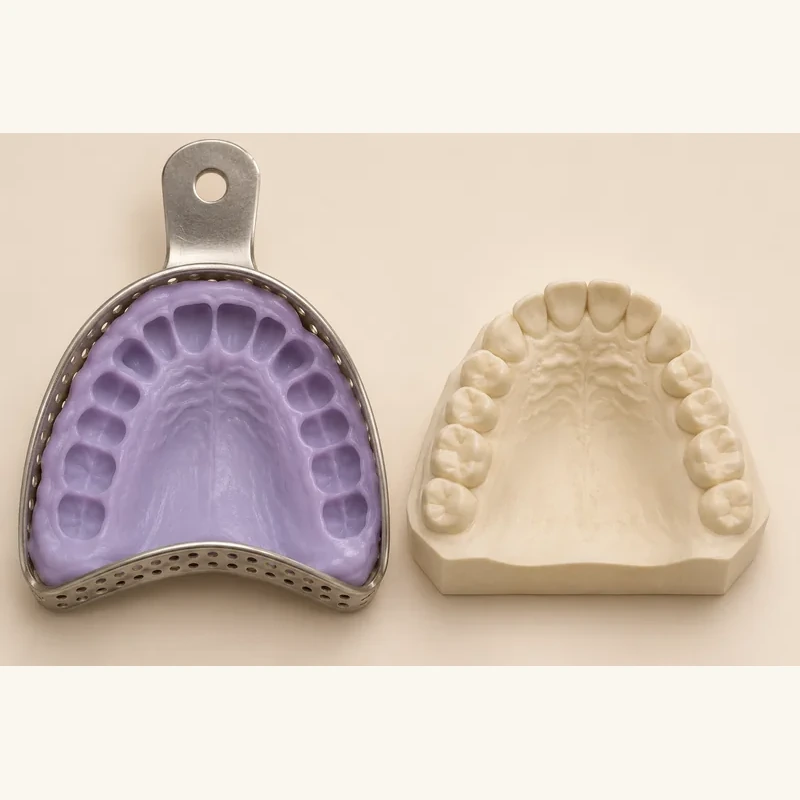
The elastic material records the surface. Taking the impression is a working step, not the finished restoration.
Depending on the technique, thicker materials support the impression while flowing materials record details. The combination must be approved for use.
Mixing, setting time and visible margins are checked. Cleaning, disinfection and cast production follow material instructions.
It refers to the chemical cross-linking reaction. The German abbreviation A-Silikon is not a quality grade.
No. Material class, consistency and one-stage or multi-stage approaches can differ.
In certain techniques the tray material has a different role from the flowing detail material. Other techniques use a single consistency.
Three steps. No audio.
Each scene can also be selected manually.

Silent educational film with German on-screen text and simplified teaching images. Not a patient case or a promised treatment outcome. The full English explanation is available as text.
Addition silicone names a material. One-stage or two-stage describes the impression-taking sequence.
It refers to the chemical cross-linking reaction. The German abbreviation A-Silikon is not a quality grade.
No. Material class, consistency and one-stage or multi-stage approaches can differ.
In certain techniques the tray material has a different role from the flowing detail material. Other techniques use a single consistency.
Yes. For some addition silicones, contact with latex constituents can inhibit setting. Product instructions must be followed.
This material explanation does not establish general superiority. The appropriate method depends on the clinical task and the areas that can be recorded.
You can raise this editorially suggested question during your consultation.
Which impression method can reliably record the areas needed in my case?
Which impression method can reliably record the areas needed in my case?
Request a consultationAppointment selection at DoctolibA material name alone does not guarantee complete recording of a preparation margin.
Editorial research: . General information, not an individual diagnosis or treatment recommendation. Teaching illustrations are simplified and do not depict a patient case.
If you turn this on, this website stores which guides you open, separately from advertising preferences. The markers expire after a fixed 30-day period from activation. The list is not sent to us by this feature. You can turn it off here and delete the markers.
Other people using the same browser profile can also see the markers. German and English versions share one marker. Expired entries are removed the next time you open a page with this feature; deleting browser data may remove them earlier. “Viewed” means opened, not read or completed.