When might it be considered?
In selected nonvital teeth with an open root end.

An apical plug is a deliberately placed material barrier at the end of a root canal. It may be used in selected nonvital teeth with an open root end to provide an endpoint for the remaining canal filling. It is not the same as naturally continued root development.
For training & practice ↓
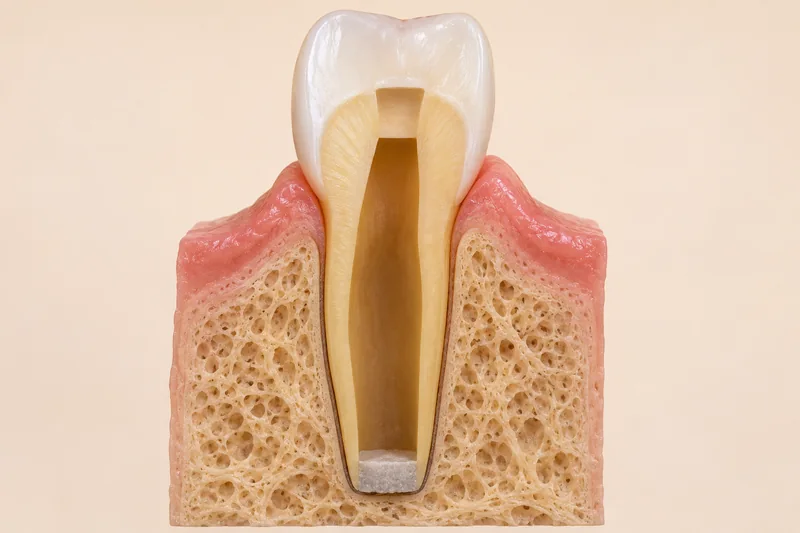
An immature permanent tooth may have a wide opening at its root tip. If the pulp becomes nonvital, treatment requires specific planning.
After the necessary cleaning and disinfection, a suitable material such as MTA may be placed as a barrier. Material and technique are selected for the findings.
Filling the remaining canal and sealing the tooth with a restoration are further steps. Thin root walls can remain a concern; a plug does not guarantee renewed root development.
In selected nonvital teeth with an open root end.
As part of planned endodontic treatment, not a complete restoration by itself.
Follow-up, a sealed restoration and assessment of remaining root structure.
Three steps. No audio.
Each scene can also be selected manually.

Silent educational film with German on-screen text and simplified teaching images. Not a patient case or a promised treatment outcome. The full English explanation is available as text.
Apexification describes an objective or approach that establishes an apical barrier in a nonvital tooth with an open apex. The plug is a deliberately placed material barrier within such a treatment concept.
No. It forms a limited barrier at the canal end. The remaining canal and the tooth crown also require appropriate treatment.
MTA is one example of a barrier material. The appropriate material is selected according to the clinical findings and the chosen procedure.
No. An artificial apical barrier does not equal continued natural root development. Regenerative procedures follow a different approach and are not suitable in every situation.
You can bring this question to your appointment:
Why is a material barrier planned for this open root end, and how will the tooth be restored afterwards?
An examination can clarify the finding and any need for referral.
Arrange an assessmentAppointment selection at DoctolibApexification describes an objective or approach that establishes an apical barrier in a nonvital tooth with an open apex. The plug is a deliberately placed material barrier within such a treatment concept.
Editorial research: . General information, not an individual diagnosis or treatment recommendation. Teaching illustrations are simplified and do not depict a patient case.