Always disease?
No.

An imaging artefact is an image-related feature that does not correspond to the actual anatomy. In dental X-rays or CBCT, movement, strongly X-ray-absorbing materials or image reconstruction can produce such appearances.
For training & practice ↓
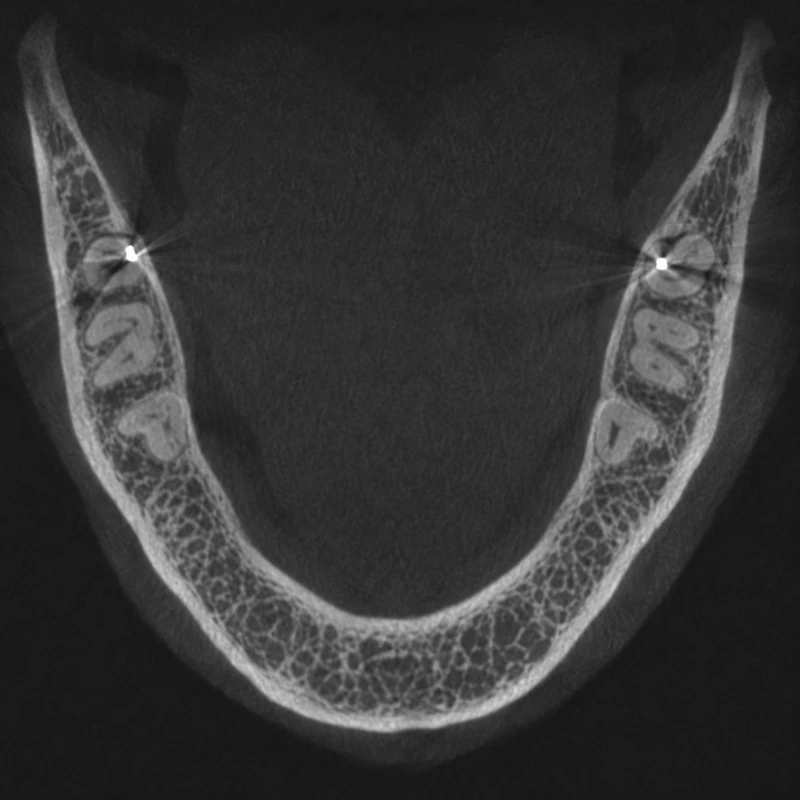
A line or shadow may arise during image formation. An unusual area is therefore not automatically a fracture, decay or inflammation.
Dense materials may produce bright or dark streaks in CBCT. Head movement can generate double contours. Different causes may have similar appearances.
The reader considers the whole dataset and clinical findings. Another exposure is not automatic; it needs its own justified diagnostic benefit.
No.
No.
No; first assess image adequacy and benefit.
Three steps. No audio.
Each scene can also be selected manually.

Silent educational film with German on-screen text and simplified teaching images. Not a patient case or a promised treatment outcome. The full English explanation is available as text.
A genuine finding describes an actual structure or change. An artefact arises from image acquisition or processing. Distinguishing them is part of professional interpretation.
Not necessarily. Material properties or movement can cause artefacts even when equipment works correctly.
No. It must be assessed with other image planes and clinical findings.
No. Improving appearance does not guarantee accurate or diagnostically sufficient information.
You can bring this question to your appointment:
Does this artefact affect the answer to our specific clinical question?
Discuss your individual findings and whether a referral is appropriate.
Discuss your findingsAppointment selection at DoctolibA genuine finding describes an actual structure or change. An artefact arises from image acquisition or processing. Distinguishing them is part of professional interpretation.
Editorial research: . General information, not an individual diagnosis or treatment recommendation. Teaching illustrations are simplified and do not depict a patient case.