For whom?
Selected restorative situations.

Raising the bite changes the vertical relationship of the upper and lower jaws when the teeth meet. It may form part of restorative planning for substantial tooth wear. Wear or jaw symptoms do not automatically mean this change is needed.
For training & practice ↓
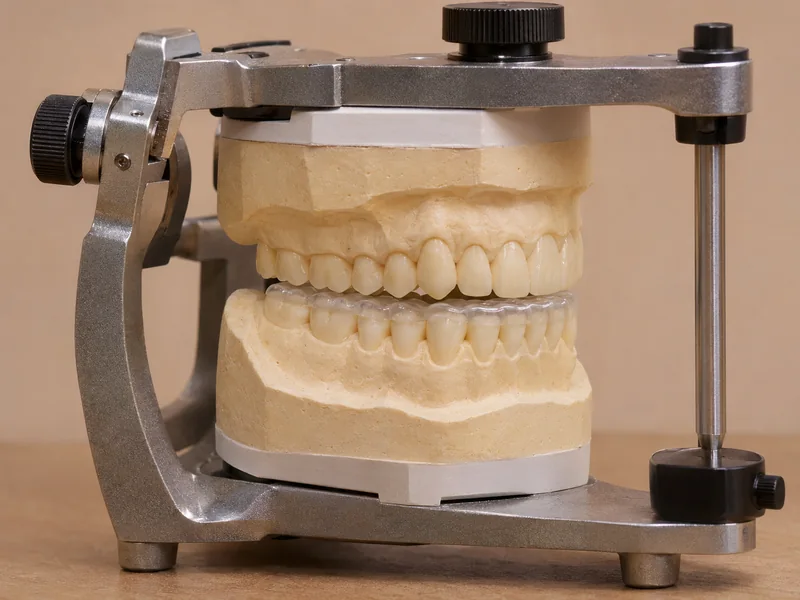
Tooth tissue, contacts, jaw movement and symptoms are examined. Wear alone does not prove loss of vertical dimension.
The proposed height and restorations are individual. A temporary trial may be appropriate depending on the findings.
Speech, chewing, contacts and tolerance are checked. An appealing image alone is not a basis for permanent change.
Selected restorative situations.
Assess function and remaining tissue.
Review tolerance and tooth contacts.
Three steps. No audio.
Each scene can also be selected manually.

Silent educational film with German on-screen text and simplified teaching images. Not a patient case or a promised treatment outcome. The full English explanation is available below.
Tooth tissue, contacts, jaw movement and symptoms are examined. Wear alone does not prove loss of vertical dimension.
The proposed height and restorations are individual. A temporary trial may be appropriate depending on the findings.
Speech, chewing, contacts and tolerance are checked. An appealing image alone is not a basis for permanent change.
Making one tooth look longer does not necessarily change the overall vertical jaw relationship.
A splint changes contacts while worn. This is different from definitive restorations.
No. Jaw symptoms have different causes; irreversible bite changes require a clear indication.
There is no universal number. Examination and planning determine the approach.
Editorially suggested question to discuss with Dr Niusha Barahmand Pour:
Has my vertical dimension truly changed, or has the wear been compensated?
Substantial wear can be assessed to establish what restoration is actually needed.
Discuss tooth wearAppointment selection at DoctolibMaking one tooth look longer does not necessarily change the overall vertical jaw relationship.
Editorial research: . General information, not an individual diagnosis or treatment recommendation. Teaching illustrations are simplified and do not depict a patient case.