Who may find this helpful?
Parents and adults noticing dark dots or lines on teeth.

Black stain describes dark, firmly attached deposits on tooth surfaces, often appearing as fine dots or a line near the gum margin. It can affect primary and permanent teeth. Appearance alone is not enough: examination needs to distinguish decay and other reasons for dark marks.
For training & practice ↓
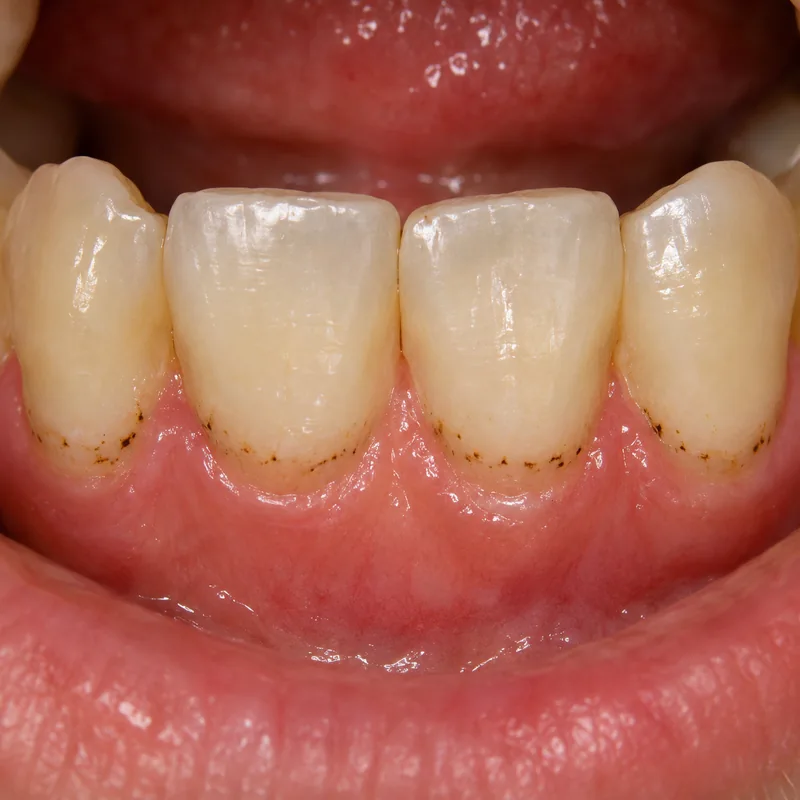
The dark layer sits on the outside of a tooth. Bacterial plaque and iron-containing compounds have been associated with its formation. This does not establish excessive iron in the body.
A dark spot may be a stain or part of a caries lesion. The cleaned tooth, surface integrity and wider findings matter.
After assessment, troublesome deposits may be professionally removed. They can return. Do not scrape them off or use acidic home remedies; usual fluoride-based tooth care remains important.
Parents and adults noticing dark dots or lines on teeth.
By examining the surface and overall tooth condition.
For pain, a defect or increasing swelling, seek prompt assessment; breathing or swallowing difficulty requires immediate medical help.
Three steps. No audio.
Each scene can also be selected manually.

Silent educational film with German on-screen text and simplified teaching images. Not a patient case or a promised treatment outcome. The full English explanation is available below.
The dark layer sits on the outside of a tooth. Bacterial plaque and iron-containing compounds have been associated with its formation. This does not establish excessive iron in the body.
A dark spot may be a stain or part of a caries lesion. The cleaned tooth, surface integrity and wider findings matter.
After assessment, troublesome deposits may be professionally removed. They can return. Do not scrape them off or use acidic home remedies; usual fluoride-based tooth care remains important.
Black stain is an external deposit; caries involves disease-related mineral loss within dental hard tissue. They can occur together.
That conclusion cannot be drawn from the colour. The composition of the deposit matters; it is not a judgement on the child or their care.
It offers no protection guarantee. Associations found in studies cannot rule out decay in an individual tooth or replace check-ups.
Not without advice. Some supplements may stain teeth; discuss prescribed treatment with the prescribing clinician. Different dark marks may have different causes.
An editorially suggested question for a discussion with Dr med dent Niusha Barahmand Pour:
Is the dark area on the surface, or has the tooth tissue changed?
Unsure about dark marks? A check-up can establish whether they are deposits or a change needing treatment.
Have a stain assessedAppointment selection at DoctolibBlack stain is an external deposit; caries involves disease-related mineral loss within dental hard tissue. They can occur together.
Editorial research: . General information, not an individual diagnosis or treatment recommendation. Teaching illustrations are simplified and do not depict a patient case.