Why record it?
As part of inflammation assessment.

Bleeding on probing means bleeding appears at a site after gentle examination with a periodontal probe. It helps assess inflammation. One bleeding site does not prove that bone loss is currently progressing.
For training & practice ↓
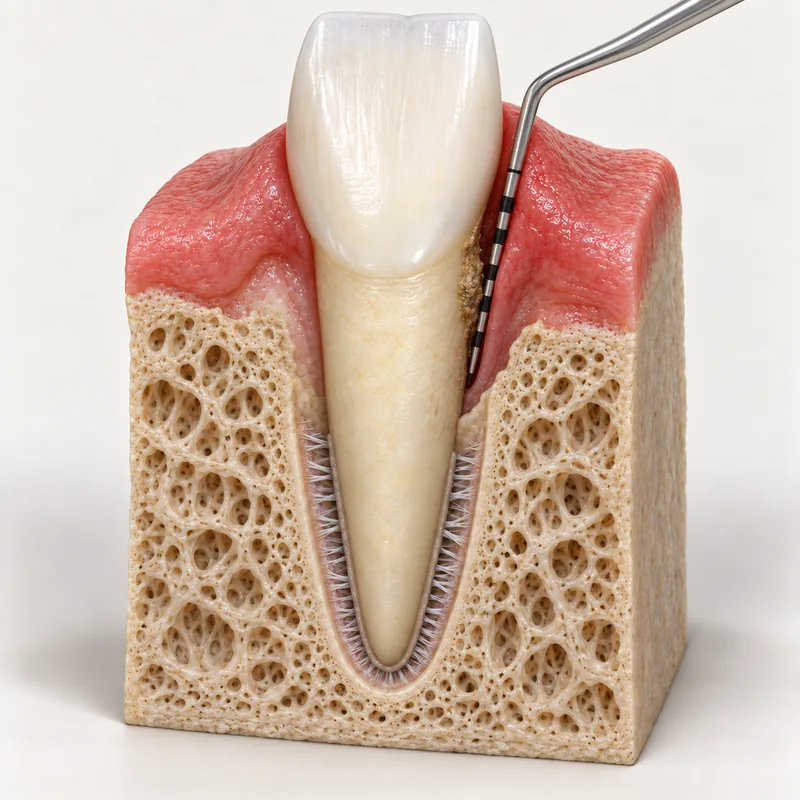
The periodontal chart records where bleeding follows probing. This differs from bleeding noticed while brushing at home.
Bleeding is interpreted with pockets, attachment and other findings. Technique and risk factors also affect interpretation.
Repeated review shows whether inflammatory signs improve or persist. Absence of bleeding does not replace assessment of ongoing concerns.
As part of inflammation assessment.
Other clinical findings and change over time.
Cleaning and treatment are planned from the whole assessment.
Three steps. No audio.
Each scene can also be selected manually.

Silent educational film with German on-screen text and simplified teaching images. Not a patient case or a promised treatment outcome. The full English explanation is available below.
The periodontal chart records where bleeding follows probing. This differs from bleeding noticed while brushing at home.
Bleeding is interpreted with pockets, attachment and other findings. Technique and risk factors also affect interpretation.
Repeated review shows whether inflammatory signs improve or persist. Absence of bleeding does not replace assessment of ongoing concerns.
BOP is recorded during a structured examination. Bleeding during brushing or spontaneously is a different observation that also deserves discussion.
No. Gingival inflammation without periodontal attachment loss can also bleed.
No. Overall findings and history matter. One apparently normal result cannot exclude every problem.
The proportion of examined sites that bleed. It is not the percentage of bone lost or an individual chance of recovery.
Editorially suggested question to discuss with Dr Niusha Barahmand Pour:
How do the bleeding sites relate to my pocket readings and previous findings?
Repeated gum bleeding is worth assessing professionally.
Have your gums assessedAppointment selection at DoctolibBOP is recorded during a structured examination. Bleeding during brushing or spontaneously is a different observation that also deserves discussion.
Editorial research: . General information, not an individual diagnosis or treatment recommendation. Teaching illustrations are simplified and do not depict a patient case.