What changes?
Position along the root axis.

Surgical extrusion involves carefully mobilising a restorable tooth and repositioning it more coronally within its own socket. A previously deep defect margin may then become accessible for restoration. Adequate remaining root support is one prerequisite.
For training & practice ↓
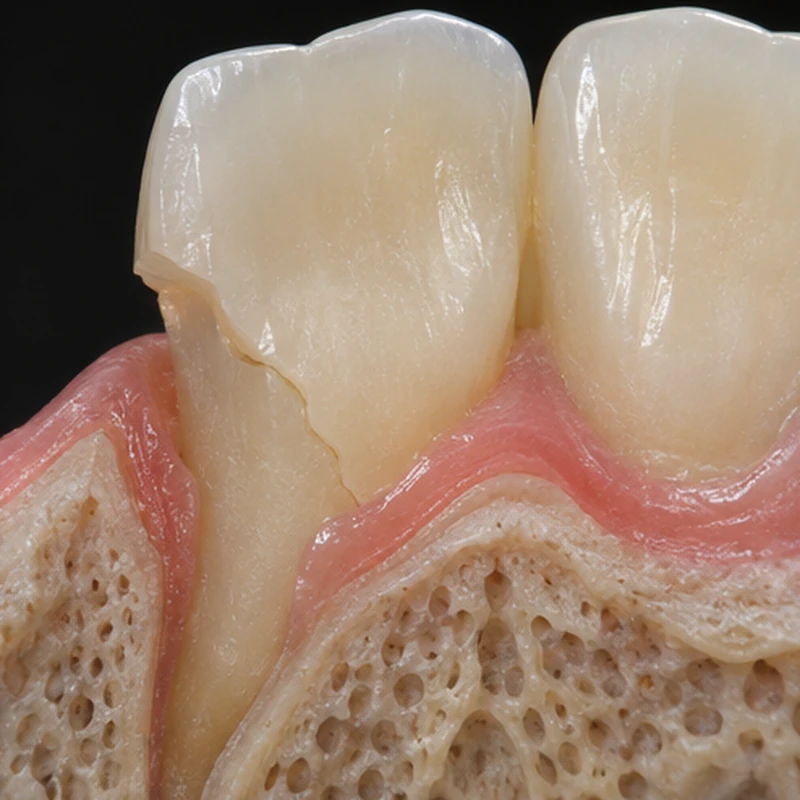
The model’s oblique line runs towards the gum. For an actual fracture the team assesses its depth and whether the remaining root can provide support.
The cutaway locates the root in its socket. During extrusion the tooth is repositioned towards the mouth within this socket. Socket shape and remaining root length limit what is feasible.
A flexible splint may temporarily stabilise the tooth. Follow-up checks the supporting tissues, possible root changes and timing of the definitive restoration.
Position along the root axis.
Adequate support for the tooth.
The root surface.
Three steps. No audio.
Each scene can also be selected manually.

Silent film with English on-screen text and simplified teaching images.
An appliance moves the tooth gradually. Surgical extrusion changes its position during a procedure.
Its own socket remains the destination. Its height changes so the damaged margin is more accessible.
Residual root length, fracture direction, bone support and the risk of injury during mobilisation matter. Other approaches may be appropriate.
Even an initially stable tooth may develop pulp, periodontal or root surface complications. Healing over time is part of assessment.
A question to bring along
How much root would remain supported by bone after extrusion?
A newly fractured tooth should be assessed promptly by a dental professional.
Choose an appointmentAppointment selection at DoctolibLong-term support requires a restorable margin and sufficient root within bone.
Editorial research: . General information, not an individual diagnosis or treatment recommendation. Teaching illustrations are simplified and do not depict a patient case.
If you turn this on, this website stores which guides you open, separately from advertising preferences. The markers expire after a fixed 30-day period from activation. The list is not sent to us by this feature. You can turn it off here and delete the markers.
Other people using the same browser profile can also see the markers. German and English versions share one marker. Expired entries are removed the next time you open a page with this feature; deleting browser data may remove them earlier. “Viewed” means opened, not read or completed.