Does every knocked tooth need one?
A simple concussion with normal mobility usually needs no splint.

A flexible trauma splint temporarily supports selected loose, displaced or fractured teeth after injury. It joins the injured tooth to its neighbours while allowing a small amount of natural movement.
For training & practice ↓
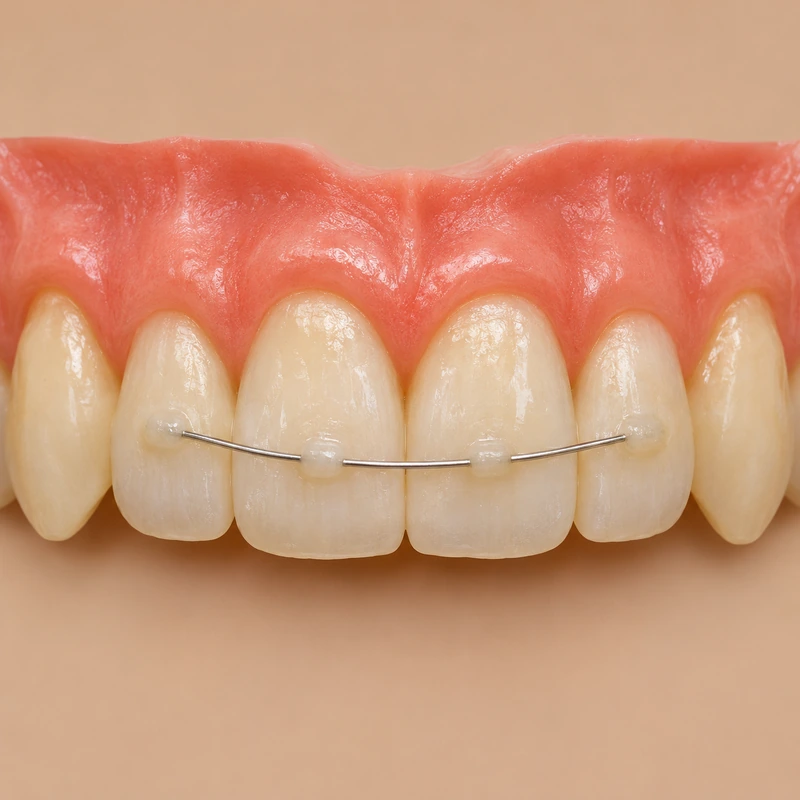
A common design uses a thin wire held by small composite pads. Passive means it supports the intended position without actively moving the tooth.
The gingival margin and spaces between the teeth should remain accessible. Ask the team to show you how to clean gently around the bonding points.
The diagnosis guides whether a splint is needed and when to remove it. Suggested durations differ for extrusion, lateral displacement and certain root fractures.
A simple concussion with normal mobility usually needs no splint.
Contact the treating practice promptly for a check of position and stability.
The splint should not interfere with closing or place unwanted pressure on a tooth.
Three steps. No audio.
Each scene can also be selected manually.

Silent educational film with German on-screen text and simplified teaching images. Not a patient case or a promised treatment outcome. The full English explanation is available as text.
A trauma splint provides support after injury. Active orthodontic appliances apply forces to produce planned tooth movement.
A simple concussion with normal mobility usually needs no splint. Position, mobility and associated injuries guide the decision.
Contact the treating practice promptly for a check of position and stability. Leave the splint in place and avoid trying to glue it back.
The splint should not interfere with closing or place unwanted pressure on a tooth. Report new interference or increasing pain.
Follow-up may continue. Position, pulp health and supporting tissues can still change after removal.
A question you could ask
How should I clean my splint, and when are review and removal planned?
After a recent dental injury, call a dental practice or an emergency dental service promptly.
Call the practice · 0221 669 401 80Telephone contactA trauma splint provides support after injury. Active orthodontic appliances apply forces to produce planned tooth movement.
Editorial research: . General information, not an individual diagnosis or treatment recommendation. Teaching illustrations are simplified and do not depict a patient case.
If you turn this on, this website stores which guides you open, separately from advertising preferences. The markers expire after a fixed 30-day period from activation. The list is not sent to us by this feature. You can turn it off here and delete the markers.
Other people using the same browser profile can also see the markers. German and English versions share one marker. Expired entries are removed the next time you open a page with this feature; deleting browser data may remove them earlier. “Viewed” means opened, not read or completed.