What does it mean?
A removable denture covering existing supporting structures.

An overdenture is a removable denture that covers retained teeth, tooth roots or implants. These can contribute support or retention. The share of support provided by the gums depends on the design.
For training & practice ↓
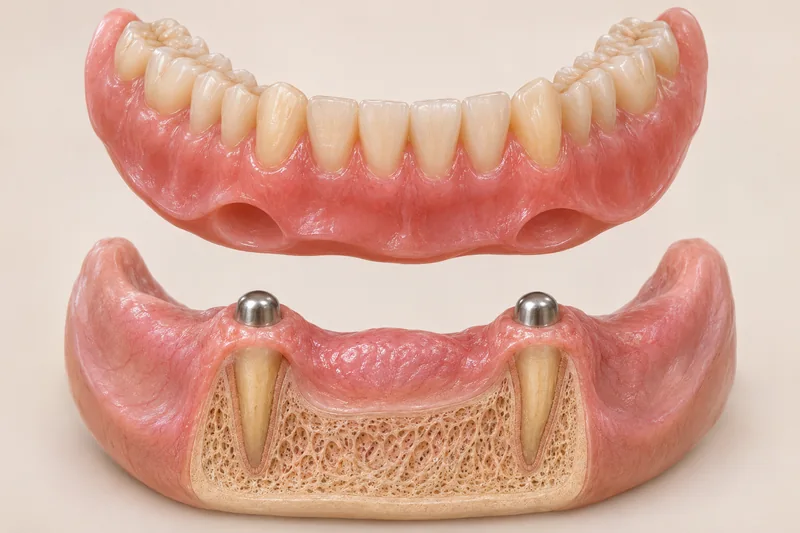
Not every denture replacing a full row of teeth rests only on the gums. Suitable teeth, roots or implant abutments may remain underneath an overdenture.
The denture may rest on prepared teeth or use additional retaining elements. The choice depends on the clinical findings and the available space.
Both the denture and its supporting structures need cleaning and review. Retained teeth remain susceptible to decay and disease of their supporting tissues.
A removable denture covering existing supporting structures.
People with selected configurations of usable teeth, roots or implants, after individual assessment.
Care and assessment of the denture, abutments and oral tissues.
Three steps. No audio.
Each scene can also be selected manually.

Silent educational film with German on-screen text and simplified teaching images. Not a patient case or a promised treatment outcome. The full English explanation is available as text.
A conventional complete denture replaces all teeth in an arch without retained natural abutments. An overdenture also uses underlying retained teeth, roots or implants.
No. Natural teeth or roots can also support an overdenture. Implants are one possible foundation, not a requirement.
No. The term describes a removable restoration. Even a securely retained denture can be removed for its planned cleaning routine.
No. Restorability, inflammation, periodontal support and the design need assessment. The name alone cannot establish whether a root is suitable.
You can bring this question to your appointment:
Which teeth or roots could appropriately be retained for my restoration?
Discuss your existing denture and potential supporting teeth.
Discuss tooth replacementAppointment selection at DoctolibA conventional complete denture replaces all teeth in an arch without retained natural abutments. An overdenture also uses underlying retained teeth, roots or implants.
Editorial research: . General information, not an individual diagnosis or treatment recommendation. Teaching illustrations are simplified and do not depict a patient case.