When should I seek care?
Promptly for recurrent biting pain or a suspected crack.

The phrase cracked tooth syndrome is used for symptoms associated with an incompletely cracked tooth. A crack may extend into dentine without a piece breaking off. Intermittent biting or cold pain can occur, but these symptoms do not prove a crack.
For training & practice ↓
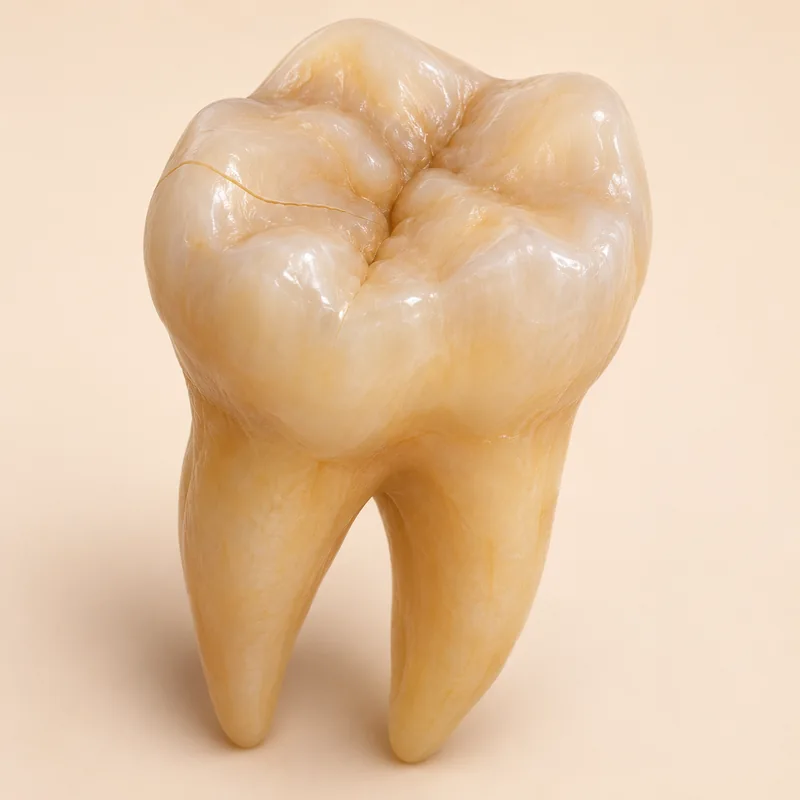
A crack may be barely visible externally. Some teeth react to loading or release; others initially have no symptoms.
Examination, targeted tests and indicated imaging help assessment. Not every crack is visible on a conventional X-ray.
Do not test it on hard objects. Treatment depends on extent, pulp condition and restorability; a crown or root canal is not automatically the answer.
Promptly for recurrent biting pain or a suspected crack.
Triggers, duration, cold sensitivity and pain on loading or release.
Hard-object bite tests and DIY repairs.
Three steps. No audio.
Each scene can also be selected manually.

Silent educational film with German on-screen text and simplified teaching images. Not a patient case or a promised treatment outcome. The full English explanation is available below.
A crack may be barely visible externally. Some teeth react to loading or release; others initially have no symptoms.
Examination, targeted tests and indicated imaging help assessment. Not every crack is visible on a conventional X-ray.
Do not test it on hard objects. Treatment depends on extent, pulp condition and restorability; a crown or root canal is not automatically the answer.
With an incomplete crack the tooth is not fully split into separate pieces. Pain alone does not reveal depth.
No. Superficial enamel lines differ from deeper cracks. A photograph cannot reliably distinguish them.
A crack in dental hard tissue does not knit together like bone. Protection and treatment must fit the findings.
Not always. Retention depends on crack extent and overall condition; it cannot be guaranteed.
An editorially suggested question for a discussion with Dr med dent Niusha Barahmand Pour:
Which findings support a crack, and what other causes need consideration?
Recurrent biting pain deserves prompt assessment. Please call and describe the symptoms.
Call the practice · 0221 669 401 80Telephone contactWith an incomplete crack the tooth is not fully split into separate pieces. Pain alone does not reveal depth.
Editorial research: . General information, not an individual diagnosis or treatment recommendation. Teaching illustrations are simplified and do not depict a patient case.