Does it involve cutting?
No. Diascopy itself is a pressure examination.

Oral diascopy is an additional clinical examination in which gentle pressure through a transparent surface is used to observe whether a mucosal lesion becomes paler. It may suggest blood within vessels. Neither blanching nor its absence establishes a diagnosis on its own.
For training & practice ↓
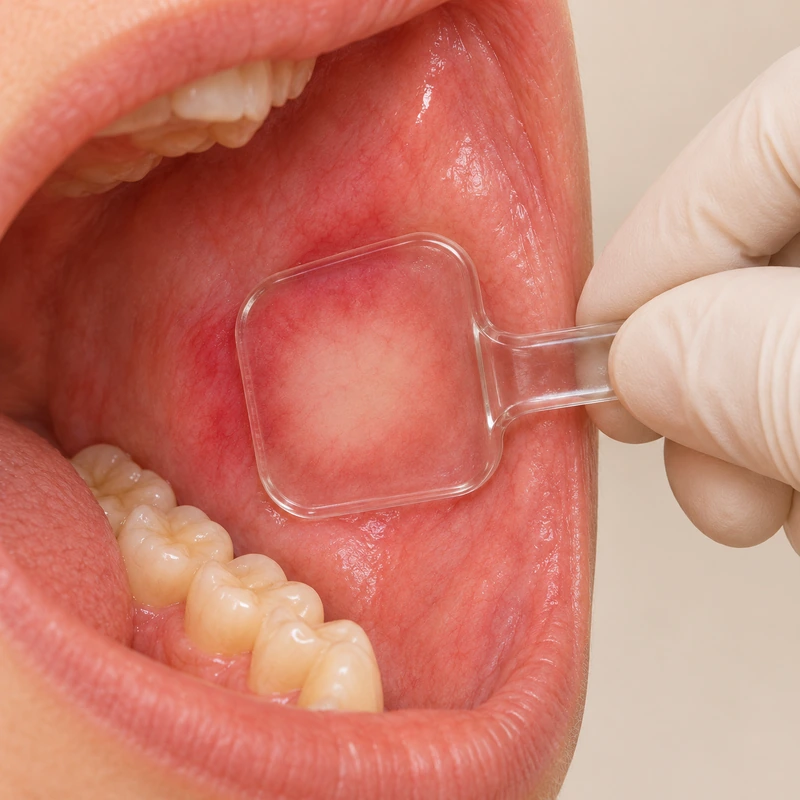
When blood in superficial vessels can be displaced, an area may look paler. The examiner interprets this together with the lesion’s appearance and history.
Not every vascular lesion blanches. Bleeding into tissue and other pigments may look similar. Diascopy therefore provides a clue, not a test of whether a lesion is benign or malignant.
Unexplained lesions may need further investigation and a carefully planned tissue sample. Do not press with glass, puncture or cut an area yourself.
No. Diascopy itself is a pressure examination.
No. It is an additional finding.
Professional assessment rather than a home test.
Three steps. No audio.
Each scene can also be selected manually.

Silent educational film with German on-screen text and simplified teaching images. Not a patient case or a promised treatment outcome. The full English explanation is available as text.
Diascopy assesses a colour change under pressure. Transillumination uses transmitted light, for example to assess tooth structures. They are different examination principles.
No. It can suggest vascular involvement but does not replace a full examination or the decision about further investigation.
No. Its diagnostic value is limited. Location, depth and the nature of the lesion may affect the finding.
Interpretation requires clinical experience, and unsuitable material or pressure can cause injury. A new, growing, bleeding or unexplained lesion should be examined.
You can bring this question to your appointment:
What does the observed colour change mean, and is further investigation needed?
An individual examination can clarify the findings and suitable next steps.
Arrange an assessmentAppointment selection at DoctolibDiascopy assesses a colour change under pressure. Transillumination uses transmitted light, for example to assess tooth structures. They are different examination principles.
Editorial research: . General information, not an individual diagnosis or treatment recommendation. Teaching illustrations are simplified and do not depict a patient case.
If you turn this on, this website stores which guides you open, separately from advertising preferences. The markers expire after a fixed 30-day period from activation. The list is not sent to us by this feature. You can turn it off here and delete the markers.
Other people using the same browser profile can also see the markers. German and English versions share one marker. Expired entries are removed the next time you open a page with this feature; deleting browser data may remove them earlier. “Viewed” means opened, not read or completed.