What does the term explain?
The position and typical shape of a tooth type.

A canine is the third tooth from the centre of a dental arch. Its crown has a prominent point. It sits between the incisors and premolars; in the primary dentition, a primary molar follows it. A complete primary dentition and a complete permanent dentition each have four canines.
For training & practice ↓
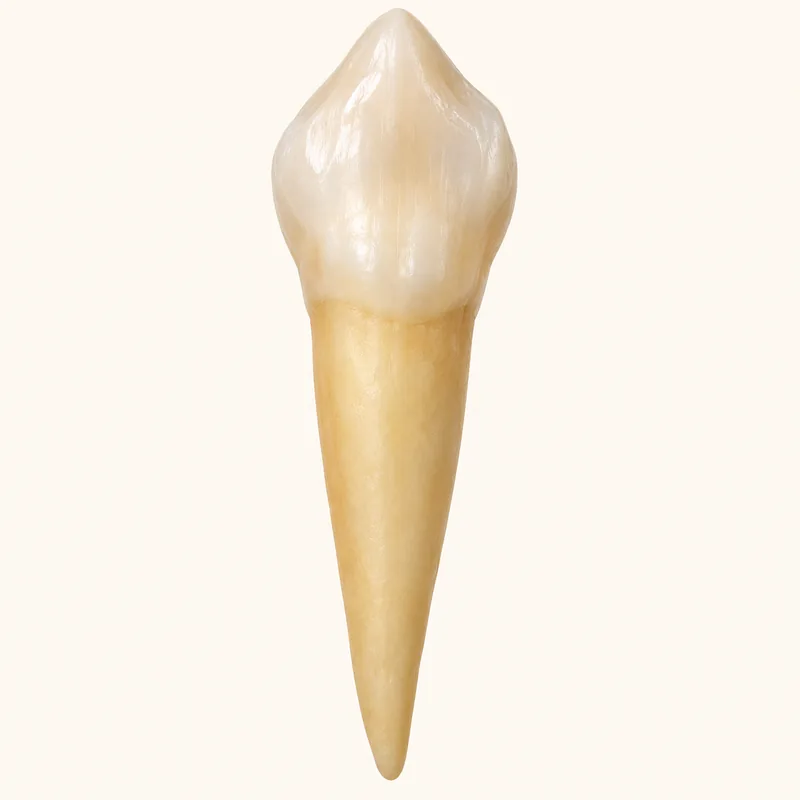
Starting at the centre, two incisors are followed by the canine. The name describes a tooth type, not a disease.
The pointed crown helps bite and tear food. A canine usually has one long root; individual anatomy can vary.
Children have canines too. Primary canines are replaced by permanent ones during tooth replacement. An examination establishes the individual situation.
The position and typical shape of a tooth type.
Not in itself. Tooth condition, position and symptoms matter.
By examination, with further imaging only when needed to answer the specific question.
Three steps. No audio.
Each scene can also be selected manually.

Silent educational film with German on-screen text and simplified teaching images. Not a patient case or a promised treatment outcome. The full English explanation is available below.
Starting at the centre, two incisors are followed by the canine. The name describes a tooth type, not a disease.
The pointed crown helps bite and tear food. A canine usually has one long root; individual anatomy can vary.
Children have canines too. Primary canines are replaced by permanent ones during tooth replacement. An examination establishes the individual situation.
The canine is the third tooth from the centre. A premolar is a small back tooth behind it, with a different chewing-surface shape.
A visible point is part of its normal shape. Whether a particular shape, wear pattern or position needs treatment depends on the findings and symptoms.
No. Incisors have a cutting edge, while canines have a more prominent point. Both are in the front part of the dentition.
It may not have erupted, may be displaced or may be absent. A photograph alone cannot distinguish these possibilities; a dental examination is appropriate.
An editorially suggested question for a conversation with Dr. med. dent. Niusha Barahmand Pour:
Is the position of my canine unremarkable, or should it be examined more closely?
An unfamiliar tooth position or unclear finding can be discussed in person.
Discuss a tooth positionAppointment selection at DoctolibThe canine is the third tooth from the centre. A premolar is a small back tooth behind it, with a different chewing-surface shape.
Editorial research: . General information, not an individual diagnosis or treatment recommendation. Teaching illustrations are simplified and do not depict a patient case.