What about the other side?
The denture must follow all its intended guides.

The path of insertion is the planned route a partial denture follows past the abutment teeth as it moves into its final position. Guiding surfaces and retainers are designed around this path. Your dental team can demonstrate the insertion and removal movements for your own denture.
For training & practice ↓
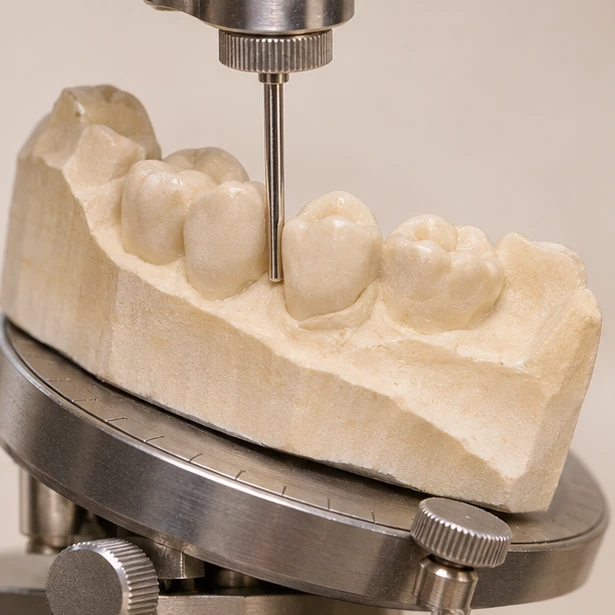
The laboratory surveys the cast. A rod helps show how the contours of several abutment teeth relate to a shared path of insertion.
Appropriately aligned guiding surfaces guide the partial denture into its seat. Prominent tooth contours can obstruct the planned route.
A flexible clasp arm can engage a suitable undercut when the denture is correctly seated. More pressure cannot compensate for the wrong path.
The denture must follow all its intended guides.
If it resists, ask for guidance on controlled seating rather than biting down forcefully.
Have any clasp that feels different assessed by the practice.
Three steps. No audio.
Each scene can also be selected manually.

Silent film with English on-screen text and simplified teaching images.
Resistance to displacement once the denture is seated.
The movement depends on your design and supporting teeth. Ask the team to demonstrate your own motion and practise it together when the denture is fitted.
Remove it without force and arrange a fit check. A bent clasp, a change at an abutment or debris may contribute.
Its retentive components engage once seated. Controlled removal follows the designed route and overcomes the retention of flexible parts.
A question to bring along
Could we practise inserting and removing my denture together?
If your partial denture starts binding, arrange a fit check before trying to change it yourself.
Choose a dental appointmentAppointment selection at DoctolibInsertion path, guidance and retention describe different features of the same design.
Editorial research: . General information, not an individual diagnosis or treatment recommendation. Teaching illustrations are simplified and do not depict a patient case.
If you turn this on, this website stores which guides you open, separately from advertising preferences. The markers expire after a fixed 30-day period from activation. The list is not sent to us by this feature. You can turn it off here and delete the markers.
Other people using the same browser profile can also see the markers. German and English versions share one marker. Expired entries are removed the next time you open a page with this feature; deleting browser data may remove them earlier. “Viewed” means opened, not read or completed.