Where is the transition?
Where the abutment or restoration emerges through the mucosa.

The emergence profile is the outer contour of the abutment or restoration where it passes through the mucosa and emerges as the visible tooth. Its curvature affects the space available to the surrounding tissue.
For training & practice ↓
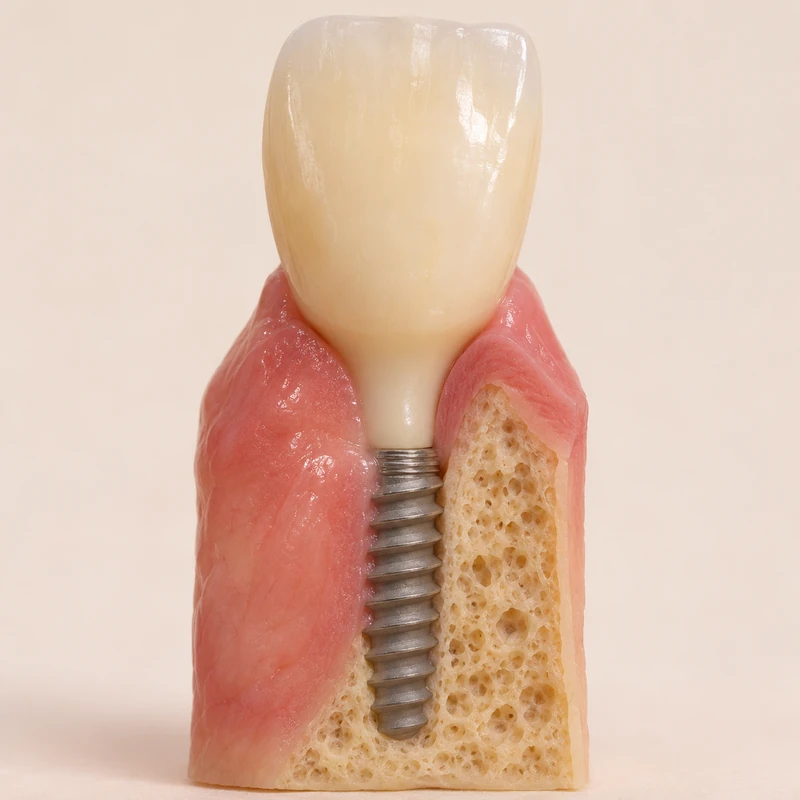
The section reveals the narrower transition between the implant and the broader visible crown.
A healing abutment maintains an opening through the mucosa during healing. An individually shaped provisional can be used to try the intended crown contour.
The transition needs to suit both the implant position and the tissues. Only part of the contour below the gum margin is visible from outside.
Where the abutment or restoration emerges through the mucosa.
Different contours around anterior implants.
The dental team and laboratory, based on the individual site.
Three steps. No audio.
Each scene can also be selected manually.

Silent film with English on-screen text and simplified teaching images.
Diameter describes the width of the implant body. Emergence profile describes the contour of the restoration above it.
Concave means curving inward. Convex means bulging outward. These words describe the shape in profile.
In a randomised study of single anterior implants, gum margin recession was more frequent with convex than with concave profiles. The finding concerns the conditions studied and the first year after restoration.
This depends on the tissues and aesthetic goals. The trial did not establish an aesthetic advantage of a provisional crown across all groups studied.
A question to bring along
How will the contour beneath the gum be shaped for my implant crown?
Questions about the contour and care of an implant crown can be raised during planning or follow-up.
Choose an appointmentAppointment selection at DoctolibMucosal margin stability and overall aesthetic appearance are different study outcomes.
Editorial research: . General information, not an individual diagnosis or treatment recommendation. Teaching illustrations are simplified and do not depict a patient case.
If you turn this on, this website stores which guides you open, separately from advertising preferences. The markers expire after a fixed 30-day period from activation. The list is not sent to us by this feature. You can turn it off here and delete the markers.
Other people using the same browser profile can also see the markers. German and English versions share one marker. Expired entries are removed the next time you open a page with this feature; deleting browser data may remove them earlier. “Viewed” means opened, not read or completed.