Does epulis mean cancer?
It is often a benign reactive growth. The word alone does not establish a diagnosis. Have any new or growing gum lump examined, even if it causes little discomfort.

Epulis is a clinical term for a localised growth on the gum. It gives the location. Several different tissue changes can produce a red or firm lump. Examination helps establish whether irritation or another cause is likely.
For training & practice ↓
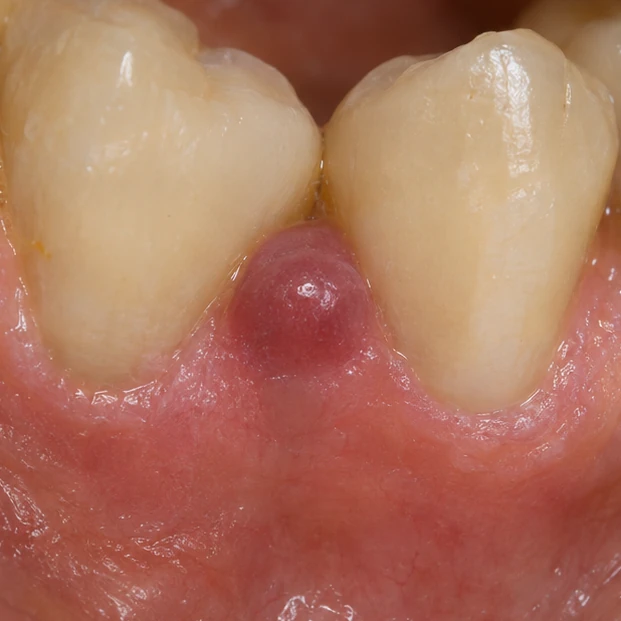
An interdental lump can be described by its location and shape before the tissue diagnosis is known.
A pyogenic granuloma is one of several possible diagnoses for a localised gum growth.
The laboratory examines the cells and the tissue architecture.
An interdental lump can be described by its location and shape before the tissue diagnosis is known.
A pyogenic granuloma is one of several possible diagnoses for a localised gum growth.
The laboratory examines the cells and the tissue architecture.
It is often a benign reactive growth. The word alone does not establish a diagnosis. Have any new or growing gum lump examined, even if it causes little discomfort.
A growth rich in blood vessels can bleed with light contact. Firmer tissue can also rub and develop a sore surface. Bleeding does not identify the type of growth.
A biopsy can distinguish, for example, a pyogenic granuloma, a fibrous growth or a peripheral giant cell granuloma. The result helps guide treatment and follow-up.
Three steps. No audio.
Each scene can also be selected manually.

Silent film with English on-screen text and simplified teaching images.
A pyogenic granuloma is one of several possible diagnoses for a localised gum growth.
It is often a benign reactive growth. The word alone does not establish a diagnosis. Have any new or growing gum lump examined, even if it causes little discomfort.
A growth rich in blood vessels can bleed with light contact. Firmer tissue can also rub and develop a sore surface. Bleeding does not identify the type of growth.
A biopsy can distinguish, for example, a pyogenic granuloma, a fibrous growth or a peripheral giant cell granuloma. The result helps guide treatment and follow-up.
A question to ask
Has the lump been described clinically or is a tissue diagnosis available?
Have a new or enlarging gum lump examined by a dentist.
Choose an appointmentAppointment selection at DoctolibDocument attachment to the gingiva or alveolar ridge, base, consistency and contact bleeding. Epulis can be a working description pending tissue diagnosis.
Editorial research: . General information, not an individual diagnosis or treatment recommendation. Teaching illustrations are simplified and do not depict a patient case.
If you turn this on, this website stores which guides you open, separately from advertising preferences. The markers expire after a fixed 30-day period from activation. The list is not sent to us by this feature. You can turn it off here and delete the markers.
Other people using the same browser profile can also see the markers. German and English versions share one marker. Expired entries are removed the next time you open a page with this feature; deleting browser data may remove them earlier. “Viewed” means opened, not read or completed.