Which resin is used?
Polyamide is a thermoplastic.

A removable polyamide partial denture replaces missing teeth. Its resin can flex. In some designs gum-coloured clasps wrap around neighbouring teeth.
For training & practice ↓
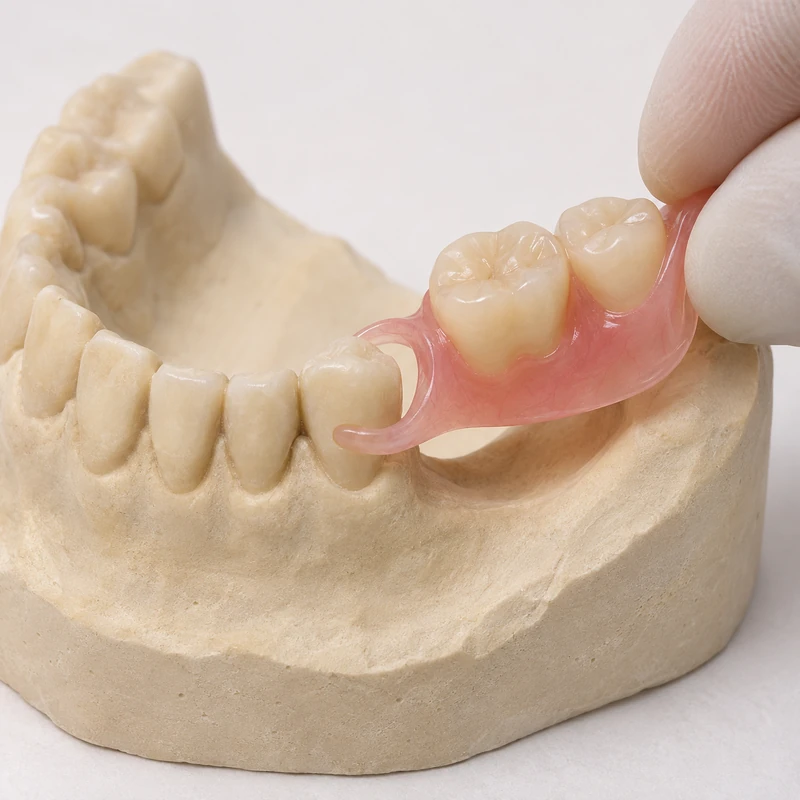
An artificial tooth sits in a pink base that transfers part of the chewing load to the supporting tissues.
A clasp engages a suitable contour of a remaining tooth. Retention and support are assessed separately.
Clean the denture and remaining teeth daily as instructed. Report rubbing or loosening.
An artificial tooth sits in a pink base that transfers part of the chewing load to the supporting tissues.
A clasp engages a suitable contour of a remaining tooth. Retention and support are assessed separately.
Clean the denture and remaining teeth daily as instructed. Report rubbing or loosening.
Polyamide is a thermoplastic.
You take it out for cleaning.
Ask how the chosen material can be adjusted or repaired later.
Three steps. No audio.
Each scene can also be selected manually.

Silent film with English on-screen text and simplified teaching images.
A flexible clasp can ease insertion. Support of the base during chewing depends on the complete design.
Gap length, the health of the remaining teeth and chewing loads have to be assessed together.
A clinical comparison in older people with upper partial dentures reports results after one year. This does not establish universal long-term superiority.
Have its fit checked. Altering the clasp yourself can change the fit and the load on the remaining teeth.
A question to bring along
How could this denture be adapted if my mouth changes?
Meet Dr. Niusha Barahmand Pour ↗Retention resists lifting. Support limits movement towards the tissues during chewing.
Editorial research: . General information, not an individual diagnosis or treatment recommendation. Teaching illustrations are simplified and do not depict a patient case.
If you turn this on, this website stores which guides you open, separately from advertising preferences. The markers expire after a fixed 30-day period from activation. The list is not sent to us by this feature. You can turn it off here and delete the markers.
Other people using the same browser profile can also see the markers. German and English versions share one marker. Expired entries are removed the next time you open a page with this feature; deleting browser data may remove them earlier. “Viewed” means opened, not read or completed.