Teeth under excitation light
Excitation light reveals differences in light emission near an incisal corner.

Natural dental tissue can absorb light at particular wavelengths and re-emit some of it at longer wavelengths. This is fluorescence. Differences between tooth structure and a filling may become more apparent when the light source can excite them.
For training & practice ↓
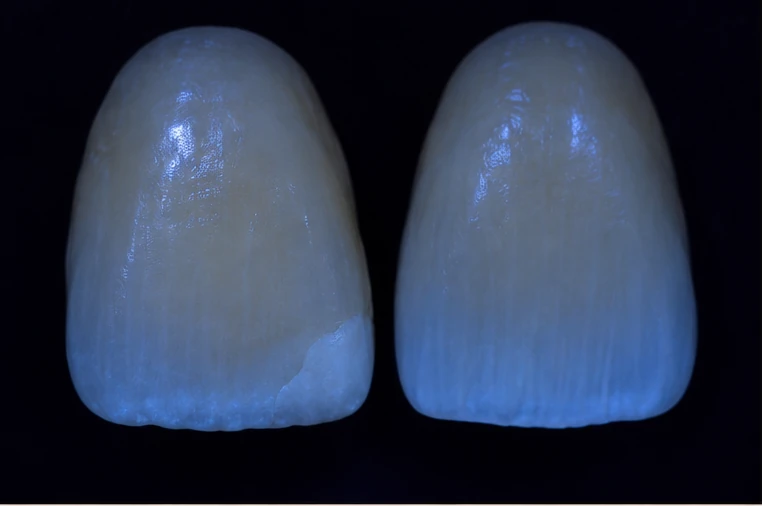
Excitation light reveals differences in light emission near an incisal corner.
The light source changes the appearance of a tooth and a comparison sample.
When matching a shade, the overall appearance is compared in suitable lighting.
Excitation light reveals differences in light emission near an incisal corner.
The light source changes the appearance of a tooth and a comparison sample.
When matching a shade, the overall appearance is compared in suitable lighting.
Excitation light reveals differences in light emission near an incisal corner.
The light source changes the appearance of a tooth and a comparison sample.
When matching a shade, the overall appearance is compared in suitable lighting.
Three steps. No audio.
Each scene can also be selected manually.

Silent film with English on-screen text and simplified teaching images.
Yes. Excitation conditions change with the light source. A difference under black light can be noticeable even though the surfaces look similar under ordinary lighting.
Yes. Excitation conditions change with the light source. A difference under black light can be noticeable even though the surfaces look similar under ordinary lighting.
Fluorescence under an arbitrary lamp cannot establish that. Assessment of tooth structure and filling margins requires a clinical examination and, when indicated, a suitable diagnostic aid.
In addition to shade and brightness, translucency and fluorescence can affect appearance. The team can compare the overall effect of restorative materials in appropriate lighting.
A question to ask
How does my front restoration look under the lighting where I notice the difference?
Choose an appointment to discuss your own tooth or restoration.
Choose an appointmentAppointment selection at DoctolibFluorescence is light emission after excitation. Opalescence involves scattering that changes appearance in reflected and transmitted light. Both effects can occur in one tooth.
Editorial research: . General information, not an individual diagnosis or treatment recommendation. Teaching illustrations are simplified and do not depict a patient case.
If you turn this on, this website stores which guides you open, separately from advertising preferences. The markers expire after a fixed 30-day period from activation. The list is not sent to us by this feature. You can turn it off here and delete the markers.
Other people using the same browser profile can also see the markers. German and English versions share one marker. Expired entries are removed the next time you open a page with this feature; deleting browser data may remove them earlier. “Viewed” means opened, not read or completed.