How many normally?
Two, one on each side.

The palatine tonsils are two collections of lymphoid tissue at the sides of the passage from the mouth to the throat. They form part of the immune system and differ from the adenoid higher up behind the nose. Tonsils are normal organs. Additional findings are needed to identify conditions such as infection or troublesome enlargement.
For training & practice ↓
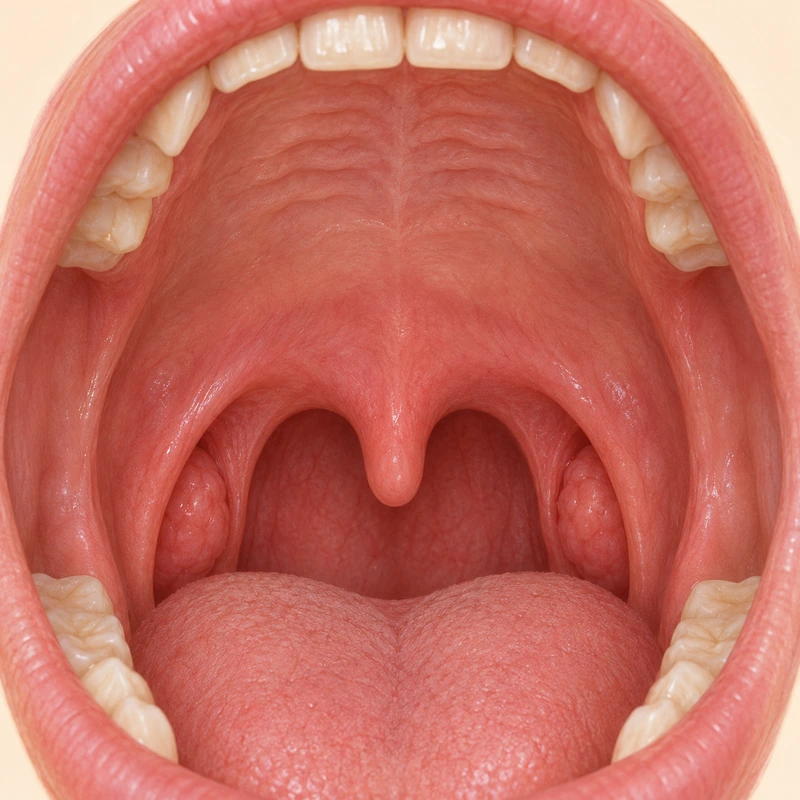
The palatine tonsils lie on either side behind the oral cavity. The uvula hanging in the middle is a different structure, not a tonsil.
Lymphoid tissue contributes to immune defence. Tonsillitis is an illness affecting that tissue. Colour or patches alone cannot reliably identify the cause.
Persistent tonsil symptoms need medical assessment, often by an ENT specialist. Call 112 for breathing difficulty or inability to swallow; do not wait for a dental visit.
Two, one on each side.
No.
A medical practitioner or ENT specialist.
Three steps. No audio.
Each scene can also be selected manually.

Silent educational film with German on-screen text and simplified teaching images. Not a patient case or a promised treatment outcome. The full English explanation is available as text.
A palatine tonsil is an organ. A peritonsillar abscess is a collection of pus around it and requires urgent treatment.
No. The adenoid lies higher in the nasopharynx. It is not visible in an ordinary mouth examination in the same way as the palatine tonsils.
Yes, unless they have been removed. Tonsil symptoms can occur at any age; age alone does not establish the cause.
No. Other causes are possible. A clinician determines whether there is a bacterial infection and whether treatment is needed, sometimes using a throat swab.
Appearance alone is not enough. Recurrent illness, symptoms and possible breathing problems are considered together in specialist assessment.
Rapidly worsening severe throat swelling, major swallowing difficulty or difficulty opening the mouth needs immediate medical assessment. Call 112 for breathing difficulty or inability to swallow.
You can bring this question to your appointment:
Is the change actually on a palatine tonsil, and do I need an ENT assessment?
Tonsil symptoms need medical or ENT assessment. A dental examination can help assess neighbouring oral or dental causes.
Discuss your dental findingsAppointment selection at DoctolibA palatine tonsil is an organ. A peritonsillar abscess is a collection of pus around it and requires urgent treatment.
Editorial research: . General information, not an individual diagnosis or treatment recommendation. Teaching illustrations are simplified and do not depict a patient case.
If you turn this on, this website stores which guides you open, separately from advertising preferences. The markers expire after a fixed 30-day period from activation. The list is not sent to us by this feature. You can turn it off here and delete the markers.
Other people using the same browser profile can also see the markers. German and English versions share one marker. Expired entries are removed the next time you open a page with this feature; deleting browser data may remove them earlier. “Viewed” means opened, not read or completed.