Where does firing take place?
In a dental ceramic furnace.

During glaze firing, a dental laboratory heats a ceramic restoration using a cycle suited to the material. An applied glaze can form a thin, glossy layer. Polishing also influences how smooth the finished surface feels.
For training & practice ↓
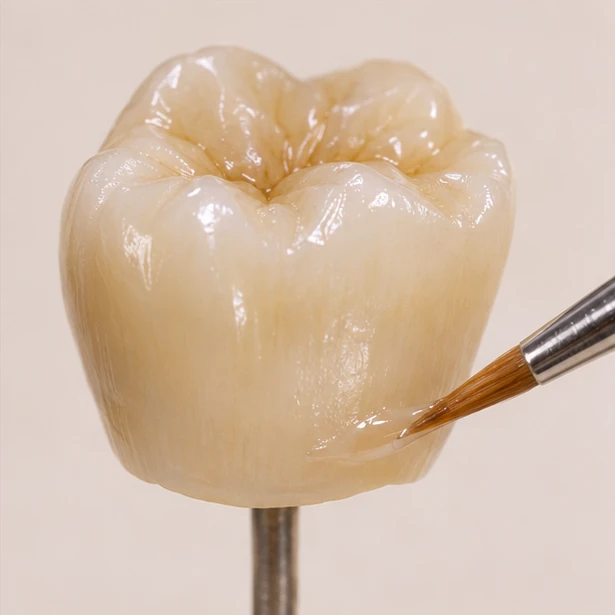
A thin coat is applied to the shaped crown. Depending on the ceramic and technique, the surface may also receive individual colour characterisation.
The applied layer changes during its firing cycle. Glazing can change the apparent shade. How much light passes through also depends on the ceramic and its thickness.
If the bite needs adjustment later, the ground area is finished again. Polishing systems are selected to suit the particular ceramic.
In a dental ceramic furnace.
Glaze can affect the apparent shade.
A suitable ceramic can also take a gloss through polishing.
Three steps. No audio.
Each scene can also be selected manually.

Silent film with English on-screen text and simplified teaching images.
Densifies the bulk material of a presintered zirconia restoration.
Glazing is used with suitable ceramics. Depending on the material, contact area and manufacturing process, a surface can also be finished by polishing.
Gloss alone tells you little about fit or bite. The surface is compared with neighbouring teeth for a natural appearance.
Point out the area. The dentist can check whether it needs further polishing and assess the bite contacts.
A question to bring along
How will the ceramic be finished if the bite needs adjusting?
A rough spot on a crown can be assessed at a dental appointment.
Choose a dental appointmentAppointment selection at DoctolibGlazing and polishing can be used together, depending on the material.
Editorial research: . General information, not an individual diagnosis or treatment recommendation. Teaching illustrations are simplified and do not depict a patient case.
If you turn this on, this website stores which guides you open, separately from advertising preferences. The markers expire after a fixed 30-day period from activation. The list is not sent to us by this feature. You can turn it off here and delete the markers.
Other people using the same browser profile can also see the markers. German and English versions share one marker. Expired entries are removed the next time you open a page with this feature; deleting browser data may remove them earlier. “Viewed” means opened, not read or completed.