How many contacts?
Several teeth contribute together.

Group function is a contact pattern in which several teeth on the working side touch simultaneously during sideways lower-jaw movement. These contacts contribute together to guidance. It differs from guidance provided only by the canines. Group function is initially a description, not automatically a malocclusion or a cause of symptoms.
For training & practice ↓
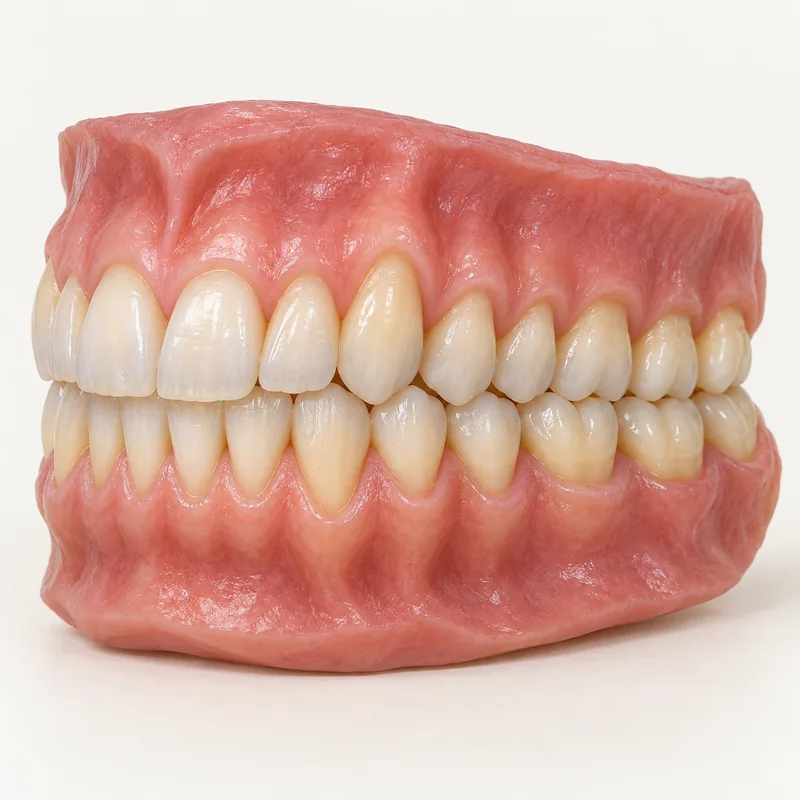
Several opposing teeth contact on the side towards which the lower jaw moves. The group may include the canine region and other teeth.
Group function means shared contacts on the working side. Balanced articulation for complete dentures is a different concept involving contacts on the opposite side as well.
The pattern is assessed with tooth condition and support, restorations and symptoms. Several contacts alone do not establish a need for treatment.
Several teeth contribute together.
The side towards which the jaw moves.
No; assess the complete findings first.
Three steps. No audio.
Each scene can also be selected manually.

Silent educational film with German on-screen text and simplified teaching images. Not a patient case or a promised treatment outcome. The full English explanation is available as text.
Group function involves several working-side contacts. Balanced articulation deliberately seeks bilateral contacts during movement, particularly in complete-denture care.
No. Group function also occurs in people without functional symptoms. The particular loading situation and other findings matter.
No. Group function describes a pattern during sideways movement. A premature contact occurs earlier during closure and needs separate assessment.
Not necessarily. Right and left contact patterns may differ. That description alone does not justify correction.
It shows contact marks, but their size is not automatically a reliable numerical measure of force.
Not routinely. A planned change needs a specific reason. A supposedly ideal pattern is insufficient justification for grinding sound teeth.
You can bring this question to your appointment:
Is my group function suitable for the remaining teeth and planned restoration, or is there a specific reason to change it?
A dental examination can clarify how this relates to your findings and treatment planning.
Discuss your dental findingsAppointment selection at DoctolibGroup function involves several working-side contacts. Balanced articulation deliberately seeks bilateral contacts during movement, particularly in complete-denture care.
Editorial research: . General information, not an individual diagnosis or treatment recommendation. Teaching illustrations are simplified and do not depict a patient case.
If you turn this on, this website stores which guides you open, separately from advertising preferences. The markers expire after a fixed 30-day period from activation. The list is not sent to us by this feature. You can turn it off here and delete the markers.
Other people using the same browser profile can also see the markers. German and English versions share one marker. Expired entries are removed the next time you open a page with this feature; deleting browser data may remove them earlier. “Viewed” means opened, not read or completed.