Is hybrid ceramic pure ceramic?
PICN is not: a polymer component is deliberately part of its structure.

Hybrid ceramic is an inconsistently used term for dental materials containing ceramic and polymer components. One more precisely defined type is PICN: a porous ceramic network infiltrated by a polymer network. Not every resin-containing CAD/CAM block has this structure.
For training & practice ↓
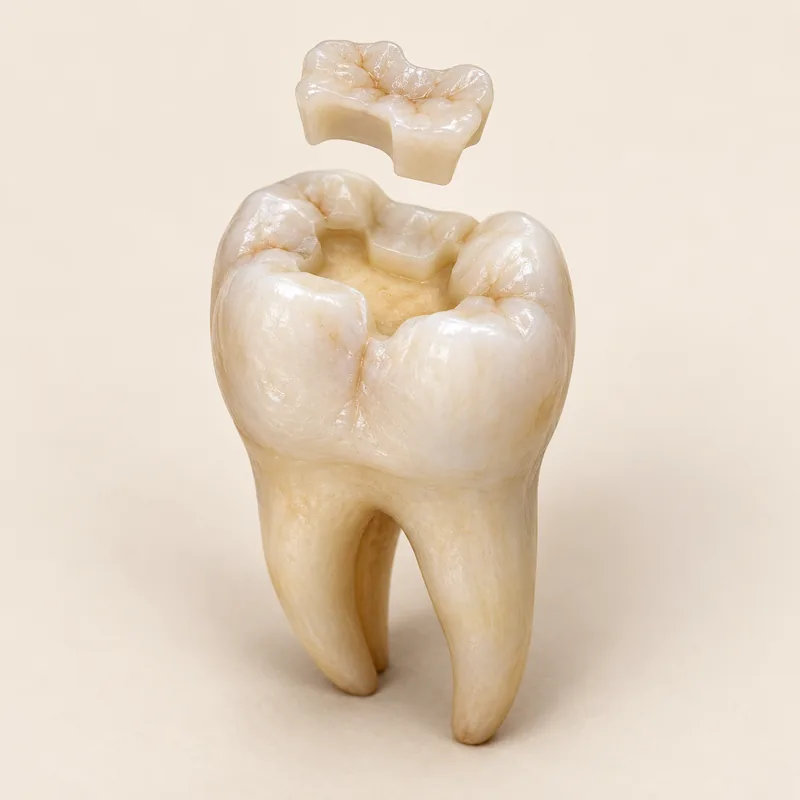
In PICN, ceramic and polymer networks interpenetrate. This differs from separate filler particles within a resin matrix.
The umbrella term hybrid ceramic is insufficient for selection. Composition and indicated use must match the specific product.
Certain PICN products are intended for single-tooth restorations. Bridges, grinding and processing require checking the relevant instructions.
PICN is not: a polymer component is deliberately part of its structure.
No. A composite containing ceramic filler particles does not automatically have a continuous ceramic network.
Some products are indicated for this. Thickness, preparation and bonding must follow their requirements.
Three steps. No audio.
Each scene can also be selected manually.

Silent educational film with German on-screen text and simplified teaching images. Not a patient case or a promised treatment outcome. The full English explanation is available as text.
Hybrid here describes material structure. Veneering is an additional outer layer on a framework.
PICN is not: a polymer component is deliberately part of its structure.
No. A composite containing ceramic filler particles does not automatically have a continuous ceramic network.
Some products are indicated for this. Thickness, preparation and bonding must follow their requirements.
That cannot be claimed generally. The referenced PICN product explicitly lists bruxism as a contraindication.
Not necessarily. Firing is prohibited for the referenced PICN product. Processing instructions cannot simply be transferred from another ceramic.
You can raise this editorially suggested question during your consultation.
Which specific material is planned, and what limitations apply?
Which specific material is planned, and what limitations apply?
Request a consultationAppointment selection at DoctolibSimilar product names can describe different internal structures.
Editorial research: . General information, not an individual diagnosis or treatment recommendation. Teaching illustrations are simplified and do not depict a patient case.
If you turn this on, this website stores which guides you open, separately from advertising preferences. The markers expire after a fixed 30-day period from activation. The list is not sent to us by this feature. You can turn it off here and delete the markers.
Other people using the same browser profile can also see the markers. German and English versions share one marker. Expired entries are removed the next time you open a page with this feature; deleting browser data may remove them earlier. “Viewed” means opened, not read or completed.