Where does the tooth go?
Back into its own socket.

Intentional replantation involves planned removal of a tooth, treatment outside the mouth and replacement in its original socket. It is considered only for carefully selected teeth.
For training & practice ↓
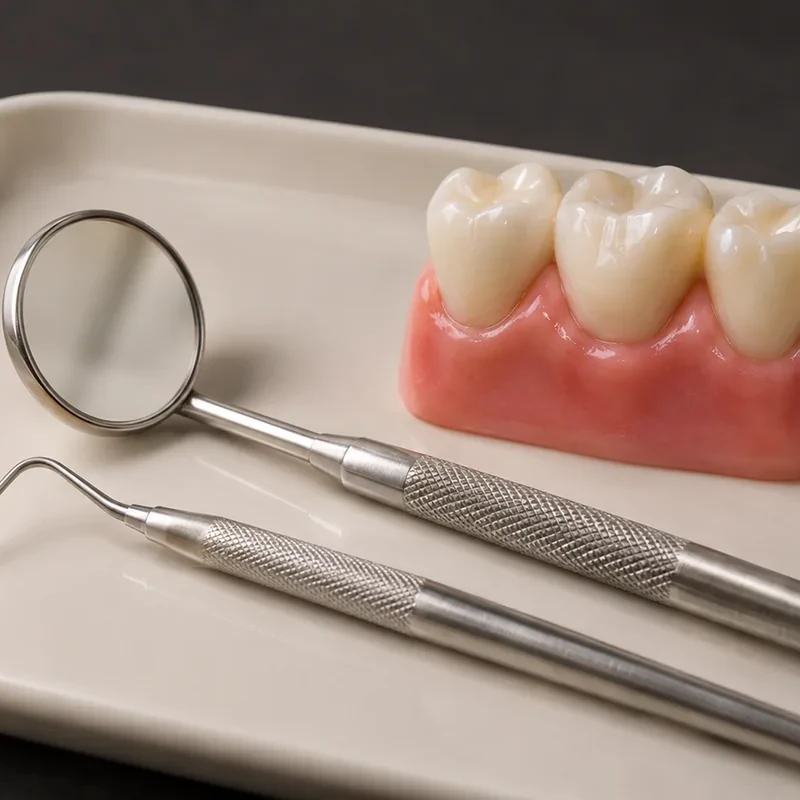
If retreatment through the crown or surgery from the root-tip side is difficult, a specialist team may assess this option.
The root surface carries delicate periodontal ligament cells and fibres. Gentle handling and minimising time outside the mouth are central to the procedure.
After replacement the team examines stability and biting contacts. Later reviews monitor healing.
Back into its own socket.
Gentle removal of a tooth that can still be restored.
Healing of the supporting tissues and changes to the root.
Three steps. No audio.
Each scene can also be selected manually.

Silent film with English on-screen text and simplified teaching images.
A knocked-out permanent tooth is a time-sensitive emergency. Intentional replantation is planned as a clinical procedure.
Replantation returns the same tooth to its original socket. Autotransplantation moves one of your own teeth to a different site.
Root shape, bone support and the risk of fracturing the tooth during removal limit its use. Other ways of retaining the tooth are considered first.
The periodontal ligament can heal. Root resorption or direct fusion between bone and root can also develop, initially without discomfort.
A question to bring along
Why might planned removal be more appropriate than another approach for this tooth?
Bring previous findings to discuss the available options for retaining your tooth.
Choose an appointmentAppointment selection at DoctolibReplantation uses a natural tooth and its root. Implant placement inserts an artificial support into bone.
Editorial research: . General information, not an individual diagnosis or treatment recommendation. Teaching illustrations are simplified and do not depict a patient case.
If you turn this on, this website stores which guides you open, separately from advertising preferences. The markers expire after a fixed 30-day period from activation. The list is not sent to us by this feature. You can turn it off here and delete the markers.
Other people using the same browser profile can also see the markers. German and English versions share one marker. Expired entries are removed the next time you open a page with this feature; deleting browser data may remove them earlier. “Viewed” means opened, not read or completed.