Who may find this useful?
People with spaces that a small brush can access safely.

An interdental brush is a small brush for spaces that can be accessed safely between teeth. Its bristles should reach the facing tooth surfaces. It complements brushing with fluoride toothpaste; the size and technique need to suit each space.
For training & practice ↓
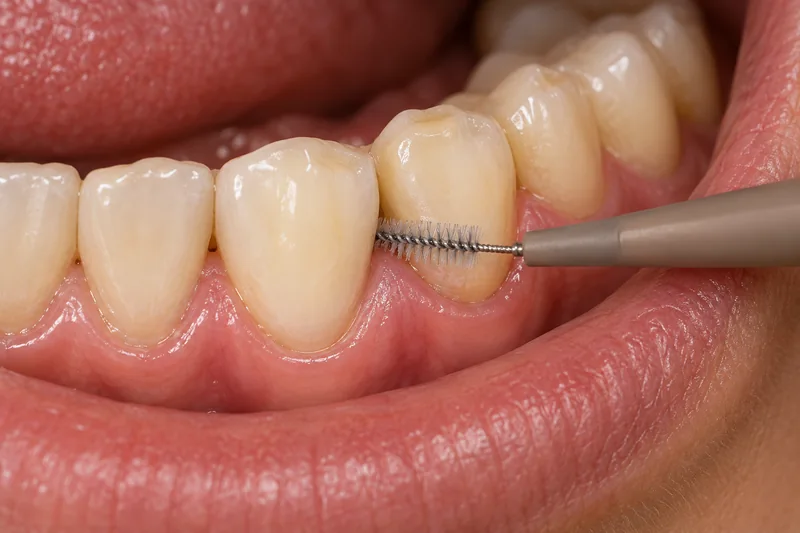
Gaps are not all the same size. A suitable brush enters without force and reaches the neighbouring surfaces. More than one size may be needed in the same mouth.
The bristles disrupt soft plaque where a full-size toothbrush has limited reach. Do not push the wire forcefully into the gum; an individual demonstration helps with the angle.
Floss may be more suitable for tight contacts. Repeated bleeding or pain calls for a review of inflammation, size and technique. An interdental brush does not remove firmly attached calculus.
People with spaces that a small brush can access safely.
By examining the spaces, fitting gently and demonstrating the technique.
Daily brushing with fluoride toothpaste and agreed check-ups.
Three steps. No audio.
Each scene can also be selected manually.

Silent educational film with German on-screen text and simplified teaching images. Not a patient case or a promised treatment outcome. The full English explanation is available below.
Gaps are not all the same size. A suitable brush enters without force and reaches the neighbouring surfaces. More than one size may be needed in the same mouth.
The bristles disrupt soft plaque where a full-size toothbrush has limited reach. Do not push the wire forcefully into the gum; an individual demonstration helps with the angle.
Floss may be more suitable for tight contacts. Repeated bleeding or pain calls for a review of inflammation, size and technique. An interdental brush does not remove firmly attached calculus.
The two clean different surfaces. An interdental brush replaces neither ordinary brushing nor professional removal of calculus.
It depends on the available space. A correctly sized brush is useful where it can enter safely. Floss serves tight contacts; one tool need not suit every space.
Bleeding can reflect inflammation or an unsuitable technique. Repeated bleeding or pain should be assessed by a dentist. Forcing a larger brush into the space is not the answer.
No. Interdental cleaning is one part of oral care. Evidence about plaque and gum health is not a guarantee against tooth decay; fluoride, diet and individual risk also matter.
An editorially suggested question for a discussion with Dr med dent Niusha Barahmand Pour:
Which sizes fit my spaces, and where would floss be more suitable?
Unsure about size or technique? An appointment can help tailor interdental cleaning to your teeth.
Discuss interdental careAppointment selection at DoctolibThe two clean different surfaces. An interdental brush replaces neither ordinary brushing nor professional removal of calculus.
Editorial research: . General information, not an individual diagnosis or treatment recommendation. Teaching illustrations are simplified and do not depict a patient case.