Is it just a retainer?
A retainer mainly maintains the position reached. A positioner may also be intended for small finishing adjustments. The wear schedule depends on its role in the individual plan.

A positioner is a removable elastic appliance that receives the upper and lower teeth. In selected cases it is used for small finishing adjustments near the end of orthodontic treatment. Each arch fits into the corresponding part of the appliance.
For training & practice ↓
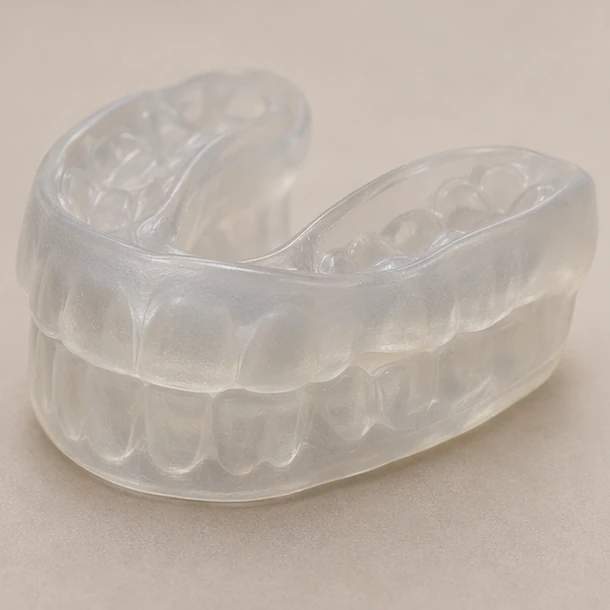
The upper and lower tooth channels are connected in this illustrative appliance.
At the finishing stage clinicians assess how the upper and lower teeth meet.
The Hawley retainer shown maintains tooth position in a single arch.
The upper and lower tooth channels are connected in this illustrative appliance.
At the finishing stage clinicians assess how the upper and lower teeth meet.
The Hawley retainer shown maintains tooth position in a single arch.
A retainer mainly maintains the position reached. A positioner may also be intended for small finishing adjustments. The wear schedule depends on its role in the individual plan.
One study followed 30 people after fixed appliances and compared them with a historical control group. Some model-based scores improved more in the positioner group over four to six weeks. This does not establish long-term stability for every bite.
Avoid forcing the teeth into an unfamiliar position. Contact the orthodontic practice about a sore spot or poor fit and bring the positioner with you.
Three steps. No audio.
Each scene can also be selected manually.

Silent film with English on-screen text and simplified teaching images.
A positioner can guide both arches together. An individual retainer stabilises teeth within the arch it fits.
A retainer mainly maintains the position reached. A positioner may also be intended for small finishing adjustments. The wear schedule depends on its role in the individual plan.
One study followed 30 people after fixed appliances and compared them with a historical control group. Some model-based scores improved more in the positioner group over four to six weeks. This does not establish long-term stability for every bite.
Avoid forcing the teeth into an unfamiliar position. Contact the orthodontic practice about a sore spot or poor fit and bring the positioner with you.
A question to ask
Which small adjustment is the positioner intended to achieve and how will it be checked?
Discuss a poor fit promptly with the treating orthodontic practice.
Choose an appointmentAppointment selection at DoctolibShort-term improvement in model scores after debonding is a different outcome from stability years later.
Editorial research: . General information, not an individual diagnosis or treatment recommendation. Teaching illustrations are simplified and do not depict a patient case.
If you turn this on, this website stores which guides you open, separately from advertising preferences. The markers expire after a fixed 30-day period from activation. The list is not sent to us by this feature. You can turn it off here and delete the markers.
Other people using the same browser profile can also see the markers. German and English versions share one marker. Expired entries are removed the next time you open a page with this feature; deleting browser data may remove them earlier. “Viewed” means opened, not read or completed.