Which finding merits early assessment?
A crossbite with a shift on closing deserves an orthodontic examination.

Early orthodontic treatment addresses selected bite problems while baby teeth are still present or during the early change to permanent teeth. The type of bite problem, its effects and the child’s growth guide the decision.
For training & practice ↓
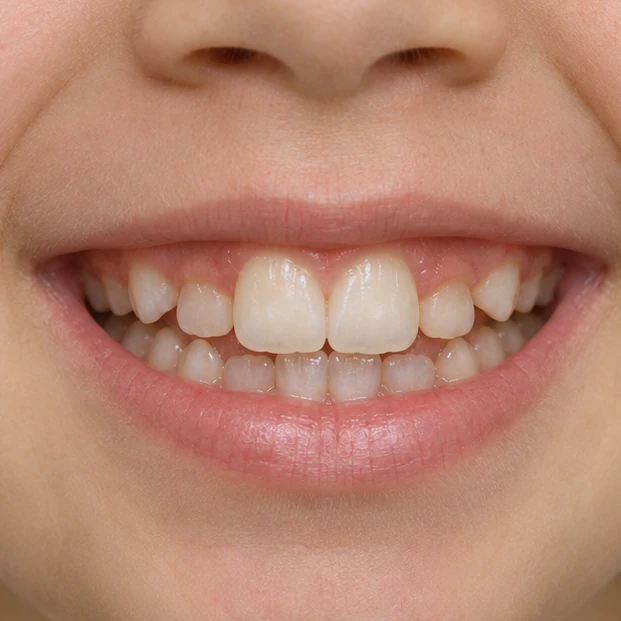
Primary and permanent teeth sit in the mouth together. The clinician looks at how the two rows meet as well as at individual teeth.
The clinician watches whether the lower jaw shifts as the child closes. A pronounced posterior crossbite can be a reason to intervene early.
An early intervention may improve a particular bite relationship. Further eruption and jaw growth guide follow-up.
A crossbite with a shift on closing deserves an orthodontic examination.
The stage of development and clinical findings matter more than a birthday.
Many tooth positions can be monitored as the remaining permanent teeth come through.
Three steps. No audio.
Each scene can also be selected manually.

Silent film with English on-screen text and simplified teaching images.
Monitoring means examining the bite over time. Early treatment starts with a specific intervention and a defined aim.
In a Class III relationship the lower teeth meet farther forwards than expected. The guideline favours early treatment for an established dental or skeletal Class III problem.
A later course may be useful when more teeth erupt or the jaw relationship changes with growth.
Mention when a sideways bite was first noticed, whether the child favours one side to chew and whether the front teeth keep knocking together.
When the lower jaw slips sideways on closing
What do we want to achieve at this stage, and when will we reassess?
Bring your observations to the dental check-up. An orthodontic assessment can follow when appropriate.
Choose an appointmentAppointment selection at DoctolibAn individual tooth erupting at an angle and a problem between the two arches are different findings. The timing also depends on whether the bite interferes with function.
Editorial research: . General information, not an individual diagnosis or treatment recommendation. Teaching illustrations are simplified and do not depict a patient case.
If you turn this on, this website stores which guides you open, separately from advertising preferences. The markers expire after a fixed 30-day period from activation. The list is not sent to us by this feature. You can turn it off here and delete the markers.
Other people using the same browser profile can also see the markers. German and English versions share one marker. Expired entries are removed the next time you open a page with this feature; deleting browser data may remove them earlier. “Viewed” means opened, not read or completed.