Which region extends back from the chin?
The horizontal, tooth-bearing mandibular body.

At the angle of the mandible, the horizontal body of the lower jaw turns upwards into the ramus. This paired bony region lies low down on either side towards the back of the face. It is an attachment area for chewing muscles.
For training & practice ↓
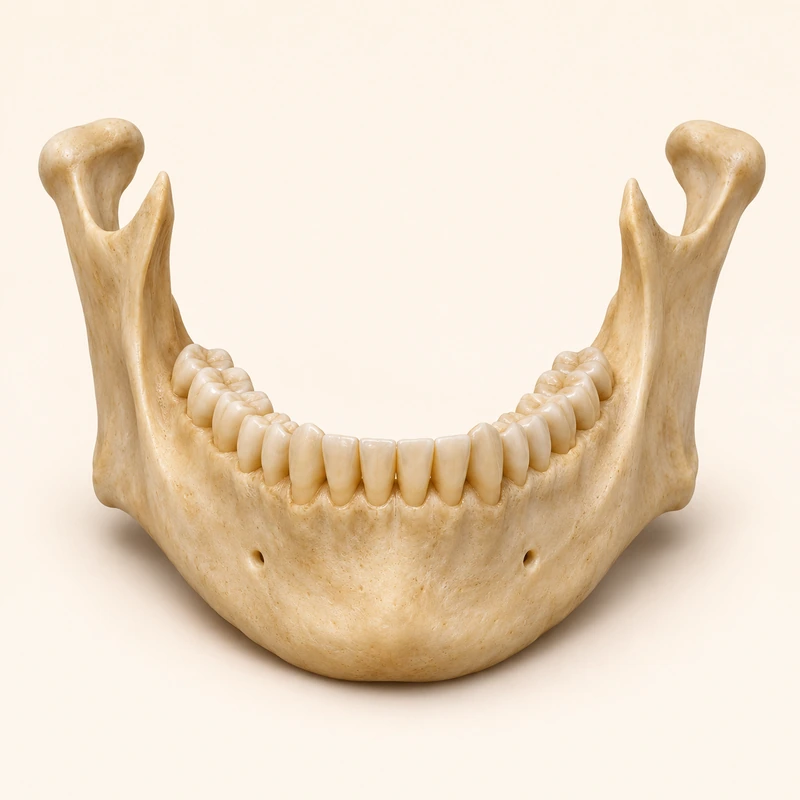
The body extends backwards from the chin. The lower teeth are anchored along its upper border.
At the rear of the body the bone rises as a broad ramus. The turn between them gives the jaw its lower rear outline.
The masseter attaches to the outside of the angle and adjacent ramus. The medial pterygoid attaches on the inner side.
The horizontal, tooth-bearing mandibular body.
The mandibular ramus.
The masseter, a strong jaw-closing muscle.
Three steps. No audio.
Each scene can also be selected manually.

Silent educational film with German on-screen text and simplified teaching images. Not a patient case or a promised treatment outcome. The full English explanation is available as text.
The angle is at the lower end of the ramus. The joint head is much higher, on the posterior projection.
The body extends backwards from the chin. The lower teeth are anchored along its upper border.
At the rear of the body the bone rises as a broad ramus. The turn between them gives the jaw its lower rear outline.
The masseter attaches to the outside of the angle and adjacent ramus. The medial pterygoid attaches on the inner side.
The body meets a ramus on the right and left. The term may refer to the region on either side.
The angle is at the lower end of the ramus. The joint head is much higher, on the posterior projection.
A question you could ask
Do you mean the bony angle, the overlying muscle or the joint higher up?
If the back of your jaw bothers you, point to the side and exact location when discussing it.
Discuss at a dental appointmentAppointment selection at DoctolibThe angle is at the lower end of the ramus. The joint head is much higher, on the posterior projection.
Editorial research: . General information, not an individual diagnosis or treatment recommendation. Teaching illustrations are simplified and do not depict a patient case.
If you turn this on, this website stores which guides you open, separately from advertising preferences. The markers expire after a fixed 30-day period from activation. The list is not sent to us by this feature. You can turn it off here and delete the markers.
Other people using the same browser profile can also see the markers. German and English versions share one marker. Expired entries are removed the next time you open a page with this feature; deleting browser data may remove them earlier. “Viewed” means opened, not read or completed.