Who is this information for?
People comparing the principles of different tooth-straightening methods.

Lingual braces are fixed appliances attached to the inner, tongue-facing surfaces of teeth. Brackets and an archwire apply forces to the teeth. They differ from removable aligner trays. Suitability depends on tooth position, bite, oral health and the available treatment options.
For training & practice ↓
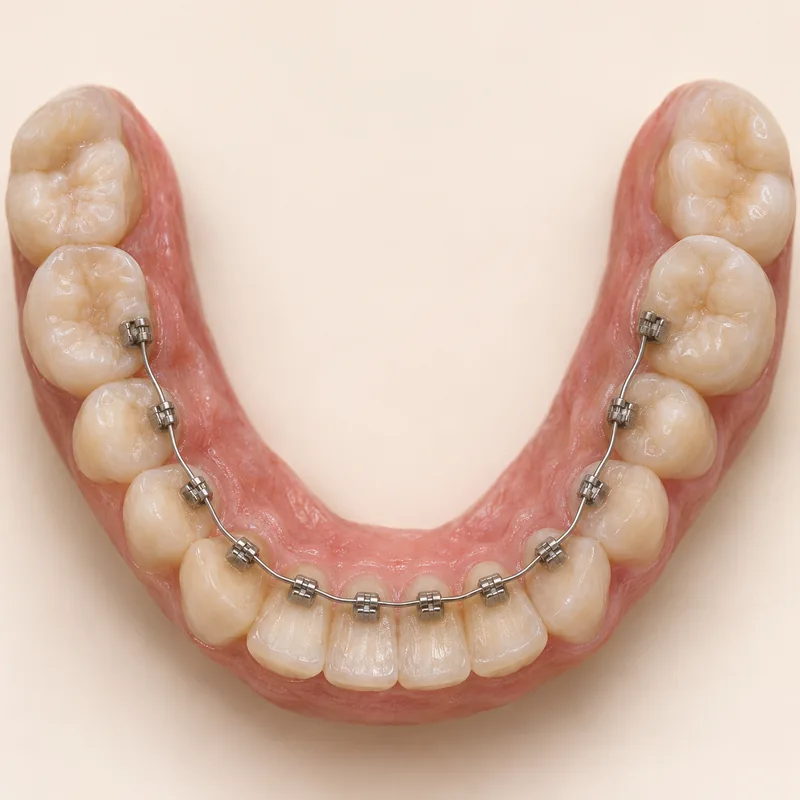
Brackets sit on the tongue-facing surfaces and are generally less noticeable from the front. Patients do not remove them for meals or cleaning.
An adjusted archwire and other components guide movement. Planning and reviews are necessary; placing an appliance inside does not automatically make treatment quicker or simpler.
Plaque needs thorough removal around brackets and wires. Suitable retention matters after active movement. Lingual treatment requires consultation with an orthodontic clinician experienced in the technique.
People comparing the principles of different tooth-straightening methods.
Through dental and, where appropriate, specialist orthodontic assessment.
Lingual braces require consultation with an orthodontic clinician experienced in the technique.
Three steps. No audio.
Each scene can also be selected manually.

Silent educational film with German on-screen text and simplified teaching images. Not a patient case or a promised treatment outcome. The full English explanation is available below.
Brackets sit on the tongue-facing surfaces and are generally less noticeable from the front. Patients do not remove them for meals or cleaning.
An adjusted archwire and other components guide movement. Planning and reviews are necessary; placing an appliance inside does not automatically make treatment quicker or simpler.
Plaque needs thorough removal around brackets and wires. Suitable retention matters after active movement. Lingual treatment requires consultation with an orthodontic clinician experienced in the technique.
Both can sit behind teeth. A lingual brace actively moves teeth; a retainer aims to maintain the position reached.
They are less visible from the front, but invisibility cannot be promised in every view or situation.
No. They are fixed to the teeth. Aligners are removable trays whose effect depends on agreed wear time.
Not universally. Required movements, dental health and practical handling need assessment together.
An editorially suggested question for a discussion with Dr med dent Niusha Barahmand Pour:
Which movements would be needed, and which service should assess the relevant methods?
Unsure which type of tooth correction is meant? A discussion can clarify whether an aligner consultation or specialist orthodontic assessment fits the question.
Discuss tooth positionAppointment selection at DoctolibBoth can sit behind teeth. A lingual brace actively moves teeth; a retainer aims to maintain the position reached.
Editorial research: . General information, not an individual diagnosis or treatment recommendation. Teaching illustrations are simplified and do not depict a patient case.