Is it contagious?
The irritant dermatitis itself is not contagious.

Repeated licking and drying irritate the skin barrier. A scaly red or darker area may develop within reach of the tongue around the lips.
For training & practice ↓
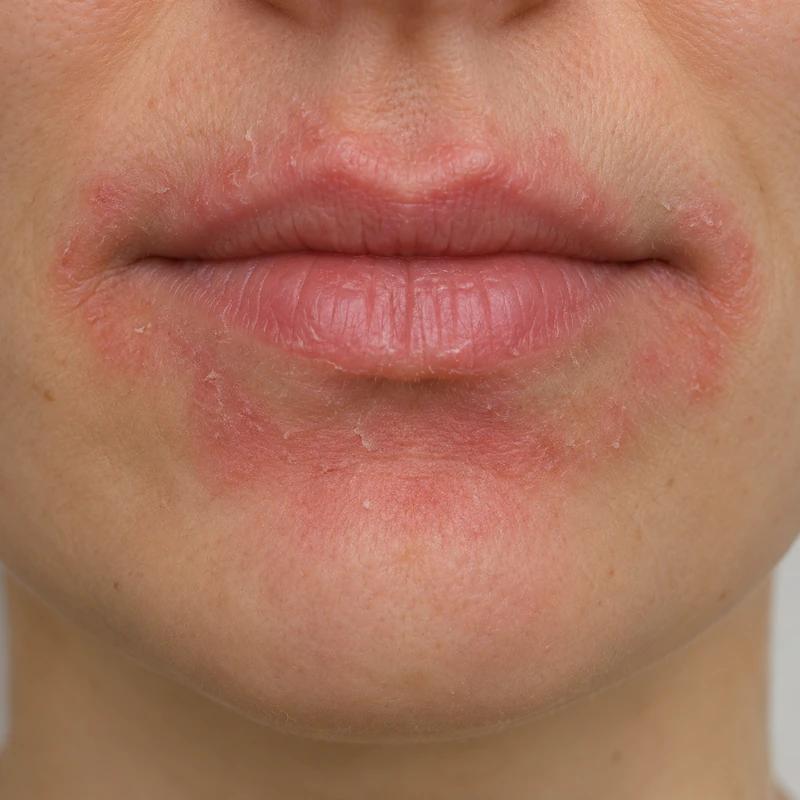
Irritation can cross the border of the lip onto the surrounding skin. Its extent often corresponds to the reach of the tongue.
Saliva moistens the skin briefly. Repeated wetting and drying disrupt the protective barrier.
Gentle, bland skin care and reducing licking give the skin a chance to recover.
The irritant dermatitis itself is not contagious.
It may involve both the vermilion and nearby skin.
Licking to relieve tightness can perpetuate the cycle.
Three steps. No audio.
Each scene can also be selected manually.

Silent film with English on-screen text and simplified teaching images.
Saliva acts as an irritant in lip licker’s dermatitis. Allergy may be triggered by an ingredient in a lip product.
A bland, fragrance-free ointment can protect the barrier. Avoid products that increase burning or redness.
Contact allergy, other forms of eczema and infection are possibilities. Distribution and history help distinguish them.
Have the area examined if it persists despite gentle care, cracks painfully, weeps or crusts.
A question to bring along
Do the pattern and history suggest irritation or should I see a dermatologist?
Seek medical assessment for persistent changes of the lips or surrounding skin.
Choose an appointmentAppointment selection at DoctolibLip care can protect the barrier. Repeated saliva exposure can still keep the dermatitis going.
Editorial research: . General information, not an individual diagnosis or treatment recommendation. Teaching illustrations are simplified and do not depict a patient case.
If you turn this on, this website stores which guides you open, separately from advertising preferences. The markers expire after a fixed 30-day period from activation. The list is not sent to us by this feature. You can turn it off here and delete the markers.
Other people using the same browser profile can also see the markers. German and English versions share one marker. Expired entries are removed the next time you open a page with this feature; deleting browser data may remove them earlier. “Viewed” means opened, not read or completed.