Are tonsil stones contagious?
A stone is a deposit and does not spread between people.

Tonsil stones are small, firm deposits in the pits of the tonsils. Cells, food particles and microorganisms can accumulate and mineralise there. Many stones cause no symptoms.
For training & practice ↓
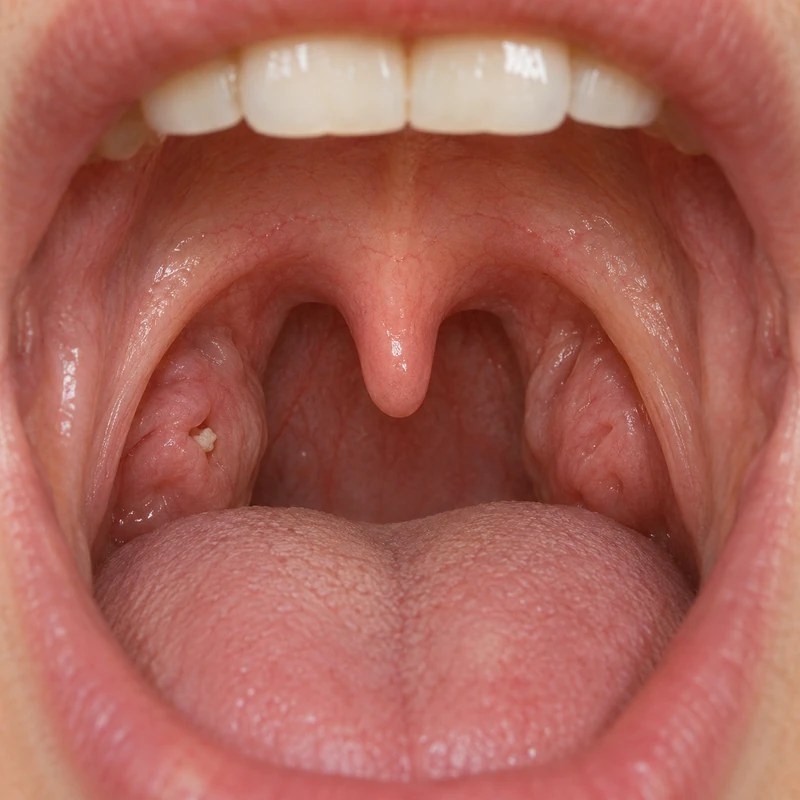
A small pale plug may be visible in a tonsil pit. The tonsils sit on either side of the throat.
Material collects in the crypts and can harden. Stones vary in size and how easily they can be seen.
Bad breath and a feeling of something stuck can occur. Pain or fever may have a different cause.
A small pale plug may be visible in a tonsil pit. The tonsils sit on either side of the throat.
Material collects in the crypts and can harden. Stones vary in size and how easily they can be seen.
Bad breath and a feeling of something stuck can occur. Pain or fever may have a different cause.
A stone is a deposit and does not spread between people.
A typical site is a palatine tonsil crypt on either side of the throat.
A GP or ENT clinician can assess the cause.
Three steps. No audio.
Each scene can also be selected manually.

Silent film with English on-screen text and simplified teaching images.
Infection can cause patches, throat pain and fever. Colour alone cannot reliably distinguish the causes.
Small stones often come away on their own. Regular oral hygiene and adequate hydration can help limit accumulation.
Tongue coating, gum disease and other causes are possible. The mouth and throat should be examined.
Seek same-day medical advice for severe one-sided throat pain, fever or major swallowing difficulty. Call 112 in Germany for acute breathing difficulty.
A question to bring along
Could my breath also be related to my tongue, teeth or gums?
Seek dental assessment for persistent bad breath and medical advice for recurring throat symptoms.
Choose an appointmentAppointment selection at DoctolibA tonsil stone forms in a tissue crypt. Dental calculus forms on tooth surfaces.
Editorial research: . General information, not an individual diagnosis or treatment recommendation. Teaching illustrations are simplified and do not depict a patient case.
If you turn this on, this website stores which guides you open, separately from advertising preferences. The markers expire after a fixed 30-day period from activation. The list is not sent to us by this feature. You can turn it off here and delete the markers.
Other people using the same browser profile can also see the markers. German and English versions share one marker. Expired entries are removed the next time you open a page with this feature; deleting browser data may remove them earlier. “Viewed” means opened, not read or completed.